09. 02. 2026

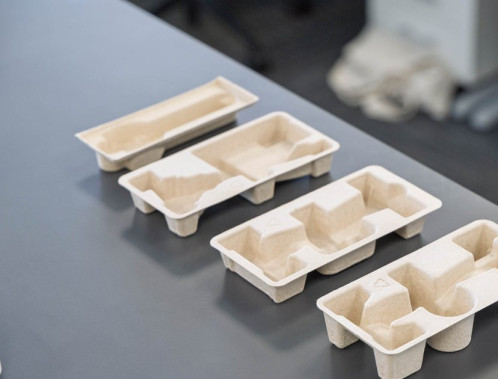
Extended Producer Responsibility (EPR) fee modulation under Regulation (EU) 2025/40 (PPWR) reduces producer fees for packaging that meets recyclability, recycled content, and design-for-circularity criteria. Molded fibre packaging typically qualifies for fee reductions in multiple categories: recyclable as paper/board (>=70% rate from 2030), eligible for recycled content credits when virgin pulp use is replaced, and structurally designed for mono-material recycling. Member States set specific modulation rates through national EPR schemes, with reductions commonly applied to fibre-based packaging meeting PPWR targets.
Extended Producer Responsibility shifts end-of-life packaging costs from municipalities to producers (brand owners, importers, first placers on market). Producers pay annual fees to national EPR schemes, which fund collection, sorting, and recycling infrastructure. PPWR Article 44 [SOURCE NEEDED] mandates that Member States modulate EPR fees based on packaging performance against circularity criteria.
Fee modulation creates financial incentives: packaging meeting recyclability targets, containing recycled content, or designed for disassembly receives fee reductions; packaging that hinders recycling (e.g. multi-material laminates, non-removable labels with incompatible adhesives) incurs fee surcharges. The core principle is polluter-pays: producers bear costs proportional to their packaging's environmental burden.
PPWR establishes three modulation categories. First, recyclability performance: fibre-based packaging must meet >=70% recyclability rate from 1 January 2030, rising to >=80% from 1 January 2038. Molded fibre packaging qualifies as paper/board under EN 643 grading, making it eligible for fee reductions in this category when recyclability thresholds are met. Second, recycled content: packaging containing post-consumer recycled material receives fee credits. Molded fibre produced from recycled paper pulp (typically 80–100% post-consumer content) qualifies. Third, design-for-circularity: mono-material construction, absence of problematic substances, and compatibility with existing recycling streams trigger additional reductions.
Member States implement modulation through national EPR schemes. Germany's VerpackG, France's CITEO, and Italy's CONAI each set specific modulation rates within PPWR minimum requirements. Producers register with the relevant scheme, report packaging weight and material composition annually, and pay fees per tonne. Fee structures typically separate packaging into material categories (paper/board, plastic, glass, metal), with fibre-based packaging paying lower base fees than plastic due to established recycling infrastructure.
For procurement managers, EPR fees are not trivial line items. Packaging fees for a mid-sized brand placing 50 tonnes of packaging annually vary substantially depending on material mix, recyclability performance, and Member State. Modulation discounts translate to annual savings that make material selection financially material.
| Criterion | Molded fibre | Plastic (PP/PS) | EPS foam | Moulded pulp laminates |
|---|---|---|---|---|
| Recyclability rate (PPWR target) | >=70% (qualifies as paper/board) | Varies; rigid PP typically lower than paper/board | Very low in most Member States | Depends on laminate composition; often under 70% |
| Recycled content eligibility | Yes (80–100% post-consumer fibre typical) | Yes (post-consumer rPP available) | Limited (post-consumer rEPS rarely used) | Yes (if fibre layer uses recycled pulp) |
| Mono-material construction | Yes (100% fibre) | Yes (single polymer type) | Yes (single polymer type) | No (fibre + barrier layer/coating) |
| Typical EPR fee (DE VerpackG, per tonne, 2026) [SOURCE NEEDED] | Substantially lower than plastic | Mid-range | Higher range | Mid-to-higher range |
| Modulation discount potential | Significant discount potential | Moderate discount (if rPP content high) | Minimal to no discount | Limited discount |
Procurement teams evaluating molded fibre against plastic alternatives should quantify EPR fee differences over product lifecycle. For a cosmetics brand placing protective packaging annually in Germany, switching from polystyrene to molded fibre substantially reduces annual EPR costs before modulation discounts. With modulation, the gap widens: molded fibre with high recycled content and mono-material construction may receive additional discounts, while polystyrene with no recycled content and low recyclability receives no modulation benefit. The cost delta compounds over multi-year product lifecycles.
EPR fee structures vary significantly across Member States, requiring market-specific analysis. French CITEO fees differ from German VerpackG rates; Italian CONAI applies distinct material classifications. Brands selling across multiple markets must aggregate modulation benefits per geography. Molded fibre's classification as paper/board is harmonised under EN 643 across EU, simplifying multi-market compliance compared to plastic grades where recyclability assessment varies by national sorting infrastructure.
Sustainability leads should integrate EPR modulation into business-case models for material transitions. Tooling cost for molded fibre packaging is €5,000–20,000 per cavity set, comparable to injection-moulding tooling, but annual EPR savings offset tooling investment at higher production volumes. For products with 5–10 year market lifecycles, cumulative EPR savings become the dominant financial variable in packaging material selection.
Procurement managers should request EPR fee calculations from packaging suppliers during RFQ processes. Suppliers registered with national EPR schemes can provide per-tonne fee estimates based on specific material composition and recyclability certifications. TRIDAS provides EUDR-compliant Due Diligence Statements per shipment under Regulation (EU) 2023/1115, supporting documentation required for EPR scheme registration and modulation claims.
TRIDAS produces molded fibre packaging from recycled paper pulp sourced primarily from EU low-risk regions, enabling high recycled content (typically 80–100% post-consumer fibre) that qualifies for EPR modulation credits. The company operates both wet press and dry press molded fibre production technologies under one roof, allowing technology selection per application: wet press for premium cosmetics and electronics packaging (thinner walls, smoother surface), dry press for protective e-commerce packaging (higher impact absorption). TRIDAS is FSC-certified and designs and manufactures its own production lines, providing approximately 4-week tooling lead times, which accelerates time-to-market for brands optimising packaging for EPR performance.