07. 31. 2026

The PPWR 40 percent empty space rule under Regulation (EU) 2025/40 requires packaging to be designed so that empty space does not exceed 40 percent of total packaging volume for most product categories from 12 August 2026. For protective packaging — e-commerce inserts, electronics packaging, industrial component packaging — this creates a conflict between minimising empty space and maintaining impact protection performance. Buyers need to understand how the rule applies to protective packaging specifically, what compliance measurement methods the regulation permits, and which design strategies reconcile empty space limits with drop-test validation requirements under ISTA and IEC standards.
Article 9 of Regulation (EU) 2025/40 establishes design requirements for packaging to minimise unnecessary material use. The regulation requires packaging to be designed and placed on the market in such a way that its weight and volume are limited to the minimum amount needed to ensure the necessary level of safety, hygiene, and acceptance for the packed product and for consumers.
The regulation sets a specific quantitative threshold: empty space shall not exceed 40 percent of the packaging volume for most product categories. This applies to transport packaging, grouped packaging, and sales packaging across the EU from 12 August 2026. The regulation does not distinguish between primary product packaging and protective inserts within the same packaging unit — both contribute to the total packaging volume assessed for empty space compliance.
For protective packaging applications — e-commerce protective inserts, consumer electronics packaging, audio equipment packaging, industrial component packaging, appliance and furniture protective inserts — the rule creates a design constraint that conflicts with impact protection requirements. Protective packaging functions by creating controlled empty space around the product to absorb drop impact energy, isolate the product from external surfaces, and suspend the product within the outer carton. Eliminating empty space entirely would eliminate impact protection.
The regulation permits two measurement methods for empty space calculation. The water displacement method involves placing the product inside the packaging, sealing all openings, submerging the complete package in water, and measuring the volume of water displaced to determine the total package volume. The product volume is then measured separately and subtracted from total package volume to calculate empty space as a percentage. The geometric calculation method measures external package dimensions to calculate total volume, then measures product dimensions to calculate product volume, with the difference representing empty space. Both methods include the packaging material itself (cartonboard, molded fibre insert walls, void fill) as occupied space, not empty space.
Member States are responsible for enforcement and may conduct market surveillance testing using either measurement method. Packaging that exceeds the 40 percent empty space threshold without valid exemption documentation may face non-compliance penalties or market withdrawal requirements.
| Technology | Typical empty space percentage | Impact protection mechanism | PPWR compliance strategy |
|---|---|---|---|
| Expanded polystyrene foam (EPS) | 30–50 percent | Material compression absorbs energy | Reduce cavity volume through tighter product fit |
| Corrugated cardboard inserts | 35–55 percent | Cardboard buckling absorbs energy | Add internal dividers to reduce cavity volume |
| Air cushion systems | 40–60 percent | Air compression absorbs energy | Difficult to reduce empty space without losing protection |
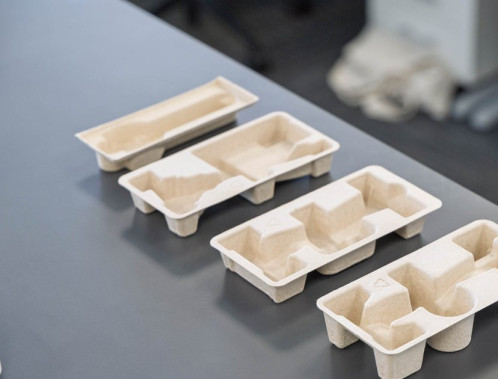
| Molded fibre protective inserts | 25–45 percent | Wall thickness and geometry absorb energy | Form-fitted design minimises cavity volume while maintaining wall thickness |
Procurement teams evaluating protective packaging for PPWR compliance from 12 August 2026 need to prioritise design strategies that minimise empty space while maintaining validated drop-test performance under ISTA 2A, ISTA 3A, or IEC 60068 standards as applicable to the product category. The most effective strategy is form-fitted protective insert design where the insert geometry follows the product contour closely, reducing cavity volume between product surface and insert wall while maintaining sufficient wall thickness for impact absorption.
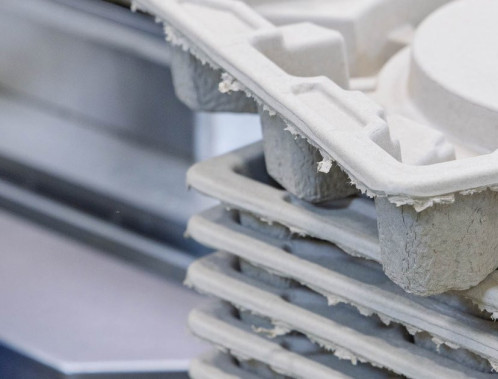
For molded fibre protective packaging, wall thickness typically ranges 2–5 mm in dry press technology, providing impact absorption through material compression and geometry deformation. Thicker walls occupy more volume within the package, which counts as occupied space rather than empty space under PPWR measurement methods. Form-fitted design that maintains wall thickness around the entire product perimeter minimises the air gap between product and insert wall, reducing empty space percentage without compromising wall thickness.
Buyers should request packaging suppliers to provide empty space calculation documentation using either water displacement or geometric calculation methods before tooling investment. For new product launches or packaging redesigns initiated in 2026, incorporating empty space calculation into the design brief ensures PPWR compliance from first production rather than requiring post-launch redesign. For existing packaging that exceeds the 40 percent threshold, buyers may need to evaluate whether the product category qualifies for regulatory exemptions (certain fragile goods, medical devices, or products with specific safety requirements) or whether packaging redesign is required.
Multi-cavity molded fibre tooling for product families with similar dimensions can reduce per-unit tooling costs while enabling form-fitted design for each product variant. TRIDAS operates both wet press and dry press molded fibre production technologies, enabling technology selection based on whether the application prioritises thinner walls with smoother surface (wet press) or thicker walls with higher impact absorption (dry press). Tooling lead time is approximately 4 weeks from order, supporting faster compliance implementation timelines than alternative molded fibre suppliers.
TRIDAS designs molded fibre protective packaging using form-fitted geometry that minimises empty space while maintaining validated impact protection performance. The company operates both wet press and dry press production technologies under one roof, enabling technology selection per application requirements — dry press for thicker-wall protective packaging where impact absorption is the primary function, wet press for thinner-wall applications where surface finish and weight reduction are priorities. TRIDAS designs and manufactures its own molded fibre production lines, providing in-house control over process parameters that influence wall thickness consistency and dimensional tolerance. For buyers implementing PPWR compliance strategies, TRIDAS provides empty space calculation documentation using geometric measurement methods during the design validation phase, before tooling manufacture.