08. 21. 2026
Custom tooling for molded fibre packaging typically costs €5,000–20,000 per cavity set in European production, with lead times of approximately 4 weeks from order at facilities manufacturing their own tooling. Minimum order quantities start from 10,000 units, varying with part complexity and tooling cavity count. These economics make molded fibre competitive with plastic injection moulding for premium non-food packaging applications including cosmetics, consumer electronics, and audio equipment where sustainability requirements justify the tooling investment.
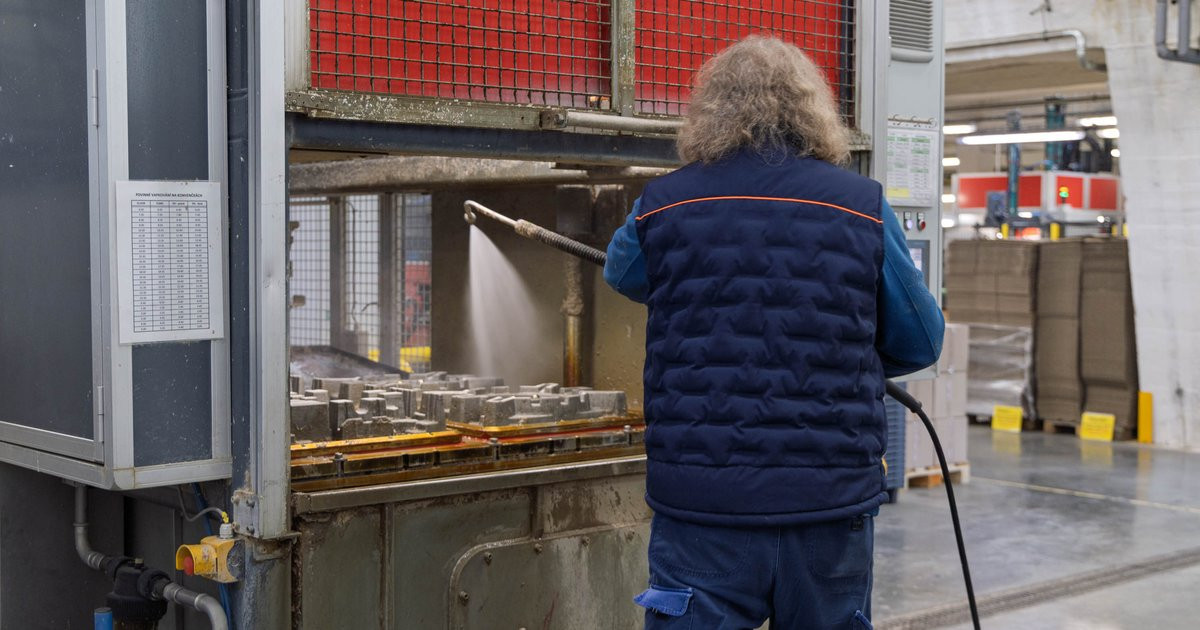
Custom tooling in molded fibre production consists of matched metal dies that shape wet pulp into three-dimensional packaging forms. The tooling comprises a forming die (typically aluminium or stainless steel with perforations for water drainage) and a pressing die (solid metal heated to 160–220°C). Both dies are CNC-machined to tolerances of ±0.2 mm to achieve consistent wall thickness and surface detail across production runs.
The tooling manufacturing process begins with 3D CAD design translated directly from the packaging specification. Design engineers incorporate draft angles of 3–7° for part release, texture patterns for visual appearance, embossed branding elements with minimum character height of 1 mm, and drainage channels optimised for the specified basis weight of 400–1,200 g/m². The dies are then CNC-machined from billet material, with forming dies receiving perforation patterns matched to the target wall thickness – typically 0.8–2 mm for wet press molded fibre or 2–5 mm for dry press molded fibre.
Tooling design differs fundamentally between wet press and dry press technologies. Wet press tooling integrates heating elements directly into the pressing die because forming and drying occur simultaneously inside the heated press at 20–60 bar pressure for 15–45 seconds. Dry press tooling separates the forming stage (where the wet pre-form is shaped) from the drying stage (which happens in a continuous oven at 180–250°C for 3–8 minutes), with the final heated pressing die used only for surface finishing and dimensional control.
Once machined, tooling undergoes trial production runs to validate dimensional accuracy, surface finish quality, and cycle time performance. European facilities manufacturing their own tooling can complete design-to-validation in approximately 4 weeks because engineering, machining, and production validation occur under one roof. Alternative molded fibre suppliers relying on external tooling manufacturers typically require 4–8 weeks for the same process due to coordination delays between tooling supplier and production facility.
| Factor | Molded fibre custom tooling | Plastic injection moulding tooling |
|---|---|---|
| Tooling cost per cavity | €5,000–20,000 | €8,000–25,000 |
| Lead time (in-house manufacture) | ~4 weeks | 6–12 weeks |
| Lead time (external tooling supplier) | 4–8 weeks | 8–16 weeks |
| Material cost per kg | Substantially lower (recycled pulp) | Higher (virgin PP) |
| Cycle time per part | 8–20 s (wet press) | 20–60 s |
| Tooling lifespan | 500,000–2,000,000 cycles | 1,000,000+ cycles |
| MOQ cost-effectiveness threshold | From 10,000 units (varies with complexity) | Higher annual volumes |
| Design iteration cost | Lower (shorter lead time, lower tooling cost) | Higher (longer lead time, higher tooling cost) |
Custom tooling economics determine whether molded fibre packaging is cost-competitive for a specific product line. The €5,000–20,000 tooling investment per cavity set is typically amortised across production volumes, with per-unit tooling amortisation improving as volumes increase. Recycled paper pulp represents a substantially cheaper input material than virgin polymers, creating favourable unit economics. At higher annual volumes, multi-cavity tooling reduces cycle time and labour cost per unit, improving competitiveness against plastic packaging.
Lead time to market is the second procurement consideration. Facilities manufacturing their own tooling compress the design-validation-production timeline by eliminating coordination delays between external tooling suppliers and production operations. This approximately 4-week tooling lead time enables faster response to product launches, seasonal packaging variants, and design iterations based on market feedback. Buyers launching premium product lines in competitive categories benefit from the shorter time-to-market window.
Tooling ownership and supplier lock-in risk differ between molded fibre and plastic packaging procurement. Molded fibre tooling is typically owned by the packaging supplier and amortised across the production contract, whereas plastic injection moulding tooling is often buyer-owned. Supplier-owned tooling reduces upfront capital expenditure but creates switching costs if the buyer changes suppliers mid-contract. Facilities offering in-house tooling design and manufacture reduce this risk because tooling modifications and replacement cavity sets can be produced rapidly without dependency on external suppliers.
Design flexibility during product development represents the third buyer consideration. Lower tooling cost and shorter lead times make iterative design refinement more economically viable in molded fibre than in plastic injection moulding. Premium packaging categories including cosmetics, fragrance, and consumer electronics frequently require multiple design iterations to achieve brand differentiation, unboxing experience targets, and retail presentation requirements. The €5,000–20,000 cost per iteration in molded fibre versus €8,000–25,000 in plastic tooling, combined with shorter lead times, supports more aggressive design optimisation within fixed development budgets.
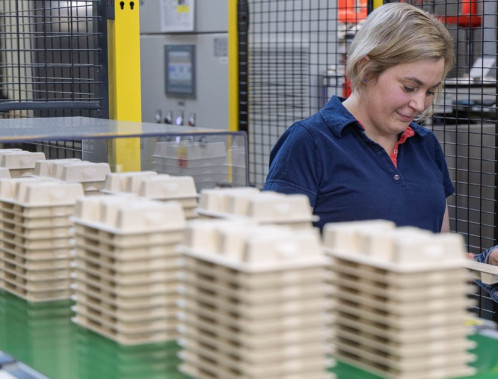
TRIDAS designs and manufactures its own molded fibre production tooling at its Czech facility, achieving tooling lead times of approximately 4 weeks from order. This in-house capability emerged from TRIDAS manufacturing its own molded fibre production lines – the engineering knowledge required to design production equipment translates directly into faster, more production-optimised tooling design. TRIDAS operates both wet press and dry press molded fibre technologies under one roof, enabling technology selection and tooling configuration matched to the specific application requirements of cosmetics, consumer electronics, audio equipment, and other premium non-food packaging categories. Procurement teams can validate tooling design and production setup during facility tours at the Valašské Meziříčí site where tooling manufacture and production lines operate in the same building.