Wet press and dry press molded fibre are fundamentally different production technologies that produce structurally and aesthetically distinct packaging materials. Wet press forms and dries pulp simultaneously inside a heated press die, creating thin-walled high-density parts with smooth surfaces suitable for premium cosmetics, fragrance, consumer electronics and audio packaging. Dry press forms pulp first, then dries it in an oven before final pressing, producing thicker-walled low-density parts with rougher texture optimised for protective applications such as e-commerce inserts, industrial component packaging and appliance protection.
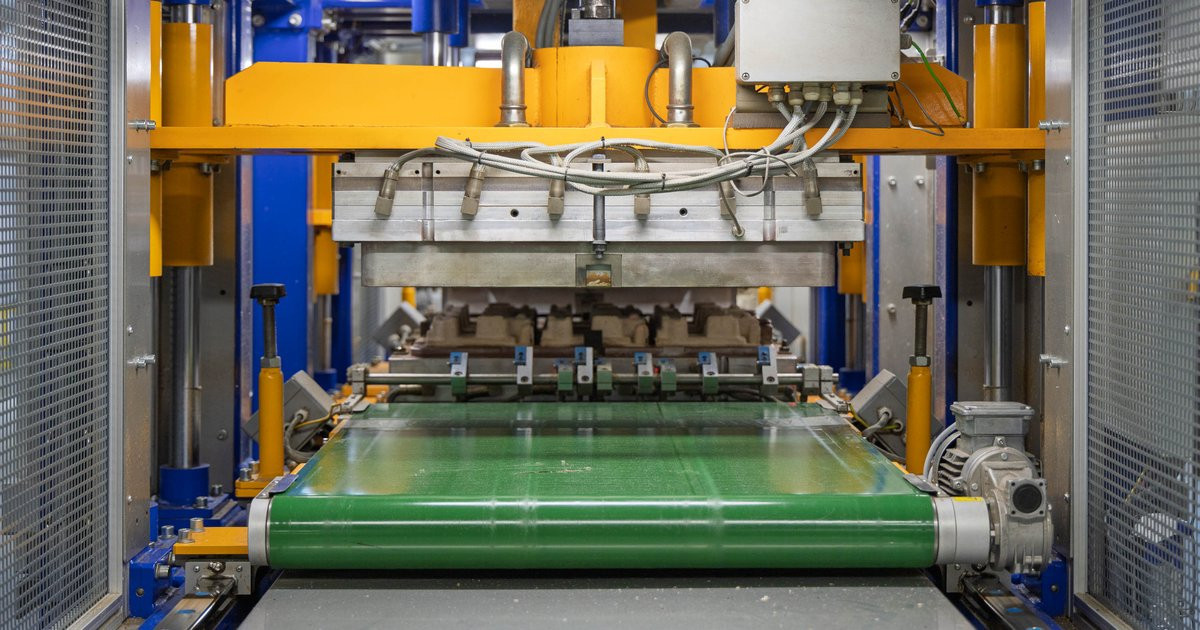
Wet press molded fibre is produced on a compact production line where forming and drying occur together inside a heated press die. The process begins with pulp slurry applied to a forming screen under vacuum to create a wet pre-form with the approximate shape of the final part. This wet pre-form—still containing 80–85% moisture—is transferred directly into a heated press die where pressure and heat are applied simultaneously. The press closes under force typically ranging 50–200 bar while die surfaces heated to 160–220°C drive moisture out of the pulp matrix as steam. Pressing duration typically runs 15–45 seconds depending on wall thickness and part geometry. The result is a thin-walled high-density part with wall thickness typically 0.8–2 mm, smooth surfaces on both sides where the heated die contacted the material, and density in the range 0.5–0.8 g/cm³. Surface finish quality is determined directly by the machined quality of the press die surface, enabling fine detail reproduction, sharp edges, and uniform surface texture suitable for direct printing or foil stamping.
Dry press molded fibre is produced on a longer continuous line with distinct forming, drying and pressing stages. The process begins identically with pulp slurry applied to a forming screen under vacuum. The wet pre-form then passes through a drying oven—typically a tunnel dryer or infrared drying section—where moisture content is reduced to approximately 8–12% over a drying period of 3–8 minutes depending on wall thickness and production line configuration. Only after drying is the now-rigid dry pre-form transferred to a heated press die for final shaping. Because the material enters the press already dry, pressing serves primarily to compress fibres and impart final shape rather than to drive out moisture. Press duration is shorter, typically 5–15 seconds. The result is a thicker-walled lower-density part with wall thickness typically 2–5 mm, rougher surface texture reflecting the forming screen pattern rather than the press die surface, and density in the range 0.2–0.4 g/cm³. The lower density and thicker walls provide superior impact absorption and cushioning performance for protective packaging applications.
Wet press molded fibre applications centre on premium non-food packaging where surface finish, branding capability and thin-wall construction are primary requirements. Cosmetics packaging—including skincare, haircare, fragrance and colour cosmetics—uses wet press technology for product trays, component inserts and outer cartons where smooth surfaces accept high-resolution offset printing, foil stamping and embossing. Consumer electronics packaging for smartphones, tablets, wearables and audio equipment uses wet press for device cradles and accessory inserts where thin walls maximise pack density and smooth surfaces prevent surface scratching during transit. Fashion accessories packaging for watches, jewellery, eyewear and leather goods uses wet press where brand presentation requires smooth surfaces and fine detail reproduction. Wine and spirits secondary packaging uses wet press for bottle presentation inserts and gift box components where smooth surfaces and structural rigidity support premium positioning.
Dry press molded fibre applications centre on protective packaging where impact absorption, cushioning performance and thick-wall construction are primary requirements. E-commerce protective packaging uses dry press for outer shipping inserts, corner protectors and void-fill components where thick walls and low density absorb shock loads during parcel handling. Industrial component packaging for automotive parts, machinery components and building materials uses dry press where heavy item weights require thick-wall construction and high compression resistance. Appliance and furniture protective packaging uses dry press for edge protectors, corner blocks and surface guards where rough texture provides friction grip and prevents product movement inside corrugated outer cases. Transport packaging for distribution and warehousing uses dry press where reusable protective inserts must withstand multiple handling cycles without structural degradation.
Combined technology product lines implement both wet press and dry press components within a single packaging system, using each technology where its performance characteristics provide optimal function. A consumer electronics product might use dry press for the outer protective shell absorbing transit shock loads while using wet press for the inner device cradle where smooth surfaces prevent scratching and thin walls maximise internal volume. A cosmetics gift set might use dry press for structural cushioning elements while using wet press for visible presentation trays where brand communication requires smooth printable surfaces. Technology combination enables procurement teams to optimise material usage, tooling investment and production cost across the complete packaging system rather than forcing a single-technology compromise.
| Characteristic | Wet press molded fibre | Dry press molded fibre |
|---|---|---|
| Wall thickness range | 0.8–2 mm typical | 2–5 mm typical |
| Density | 0.5–0.8 g/cm³ (high) | 0.2–0.4 g/cm³ (low) |
| Surface finish | Smooth both sides, die-surface quality | Rough texture, forming-screen pattern visible |
| Print quality | High-resolution offset, flexo, foil stamping possible | Screen printing or pad printing typical, coarser detail |
| Detail reproduction | Fine features, sharp edges, embossing capable | Rounded features, draft angles required |
| Impact absorption | Lower (dense structure) | Higher (cellular structure, more air voids) |
| Production line length | Compact (forming + pressing integrated) | Long (separate drying oven stage) |
| Cycle time | 15–45 seconds press duration | 3–8 minutes total (drying dominates) |
| Tooling cost | Higher (precision machined dies, tighter tolerances) | Lower (forming tools simpler, press dies less critical) |
| Tooling lead time | Typically longer (precision machining requirements) | Typically shorter (simpler tool geometry) |
| Primary applications | Cosmetics, electronics, audio, fragrance, fashion accessories | E-commerce protective, industrial components, appliance packaging |
Technology selection between wet press and dry press molded fibre is not a preference decision but a functional requirement driven by product protection needs, brand presentation requirements and end-user interaction with the packaging. Procurement teams evaluating molded fibre for the first time frequently approach technology selection from a cost-optimisation perspective, seeking the lowest-cost production method. This approach fails because wet press and dry press produce structurally incompatible materials that cannot substitute for each other. A cosmetics brand cannot use dry press for a product presentation tray where rough surface texture and thick walls conflict with brand positioning requirements. An electronics manufacturer cannot use wet press for outer protective packaging where thin walls and high density provide insufficient impact absorption during parcel drop events. Technology selection must begin with application requirements—protection performance, surface finish expectations, wall thickness constraints, print quality needs—then match those requirements to the technology that delivers them.
Surface finish differences between wet press and dry press directly determine what branding and decoration methods are feasible on the finished packaging. Wet press smooth surfaces accept high-resolution offset printing with fine screen rulings above 150 lpi, enabling photographic image reproduction, fine typography and multi-colour process printing. Foil stamping, embossing and debossing are possible on wet press surfaces because the dense fibre matrix holds fine detail without crushing. Dry press rough surfaces accept only screen printing or pad printing with coarser screen rulings typically below 85 lpi, limiting graphic complexity and colour fidelity. Brand teams accustomed to offset-printed folding cartons or litho-laminated corrugated will find wet press surface quality familiar while dry press requires adaptation to lower print resolution and coarser surface texture. This surface finish constraint is not a quality defect but a structural consequence of the production technology—the forming screen pattern that creates the rough texture also creates the cellular structure that provides impact absorption performance.
Minimum order quantities, tooling costs and lead times differ between wet press and dry press technologies due to production line configurations and tooling complexity. Wet press typically requires higher tooling investment because press dies must be precision-machined to tight tolerances to achieve smooth surface finish and fine detail reproduction. Dry press tooling is typically lower cost because forming screens and press dies have simpler geometry and looser tolerances. Lead time differences reflect tooling complexity: wet press tooling typically requires more engineering iteration and longer machining duration, while dry press tooling can often be produced more rapidly. TRIDAS operates both technologies in-house with tooling design and manufacture capabilities, enabling technology-selection consultation during the quotation stage and typical tooling lead times of approximately four weeks from order—substantially shorter than market average. Buyers moving from plastic injection moulding to molded fibre should expect tooling costs one order of magnitude lower than injection mould tooling but lead times somewhat longer than thermoforming tool production.
TRIDAS designs and manufactures production equipment for both wet press and dry press molded fibre technologies and operates both production methods in-house at its facility in Valašské Meziříčí, Czech Republic. This dual-technology capability enables application-specific technology selection per product rather than forcing customers into a single-technology constraint. TRIDAS engineers conduct technology selection consultation during project quotation by evaluating product specifications—wall thickness requirements, surface finish expectations, protection performance needs, decoration methods—against the structural characteristics each technology delivers. For customers requiring both protective and premium packaging components within a single product line, TRIDAS can produce dry press protective elements and wet press presentation components from a single facility, simplifying supply chain coordination and enabling matched material specifications across the complete packaging system. TRIDAS provides facility tours for qualified procurement teams where both wet press and dry press production lines operate under one roof, enabling direct observation of surface finish differences, wall thickness comparison and production cycle time evaluation.
Wet press can provide structural rigidity and compression resistance but delivers lower impact absorption than dry press due to its higher density and thinner wall construction. For applications where product protection requires cushioning performance during drop events or vibration damping during transit, dry press cellular structure provides superior performance. Wet press is suitable for protective applications where the primary protection mechanism is structural containment rather than impact absorption—for example, device cradles preventing lateral movement rather than absorbing vertical shock loads.
Dry press inherently produces rough surface texture reflecting the forming screen pattern because the material dries before final pressing. Post-production coating or lamination can smooth dry press surfaces, but this adds process steps and cost. For applications requiring smooth surfaces and high print quality as received from production, wet press is the appropriate technology. Dry press is optimised for applications where rough texture is acceptable or where surface finish is not critical to product function.
Wet press tooling typically costs more than dry press tooling due to precision machining requirements for smooth die surfaces and tight tolerances needed for fine detail reproduction. The cost difference varies with part complexity and size but can range from 20–40% higher for wet press. However, tooling cost for both technologies remains substantially lower than plastic injection mould tooling—typically one order of magnitude lower for comparable part size and complexity.
Consumer electronics packaging typically uses wet press technology with wall thickness 1.0–1.8 mm, providing structural rigidity for device support while minimising pack volume. Thinner walls maximise internal cavity volume within fixed outer carton dimensions, allowing more accessories or documentation to be included in the pack. Thicker walls would provide more impact absorption but are rarely necessary for inner packaging components where the outer corrugated case absorbs the majority of transit shock loads.
A product design optimised for wet press cannot typically be produced using dry press without substantial redesign, and vice versa. Wall thickness, draft angles, corner radii, feature sizes and surface detail must be designed specifically for the selected technology. Attempting to produce a wet-press-optimised design using dry press will result in weak thin sections, poor forming or surface defects. Attempting to produce a dry-press-optimised design using wet press will result in excessive material weight, long press cycles and poor economics. Technology selection must occur during initial design rather than being changed after tooling investment.
Both wet press and dry press use the same base pulp raw material—typically mechanical or chemical wood pulp from FSC-certified sources—and both produce packaging that is kerbside recyclable under EN 643 paper grades. The primary environmental difference is energy consumption during production: wet press uses more energy per unit mass because moisture must be driven out during pressing, while dry press spreads drying energy over a longer oven stage but at lower intensity. Material recyclability, recycled content capability and end-of-life disposal pathways are equivalent between technologies.
Minimum order quantities depend more on part size, production line configuration and tooling changeover time than on technology type. Wet press lines typically have shorter changeover times due to compact equipment layout, potentially enabling smaller batch sizes. Dry press lines with long drying ovens may require longer production runs to amortise changeover time. For both technologies, buyers should expect initial minimum order quantities in the range of several thousand units per SKU, with ongoing replenishment orders potentially at lower volumes once tooling is amortised.
Combined technology packaging systems are common in consumer electronics and cosmetics applications where outer protective components use dry press for impact absorption while inner presentation components use wet press for brand communication. TRIDAS produces both technologies in-house, enabling matched material specifications, coordinated production scheduling and single-source supply for multi-technology packaging systems. This approach optimises material usage and cost by applying each technology where its performance characteristics provide the greatest value.