07. 31. 2026
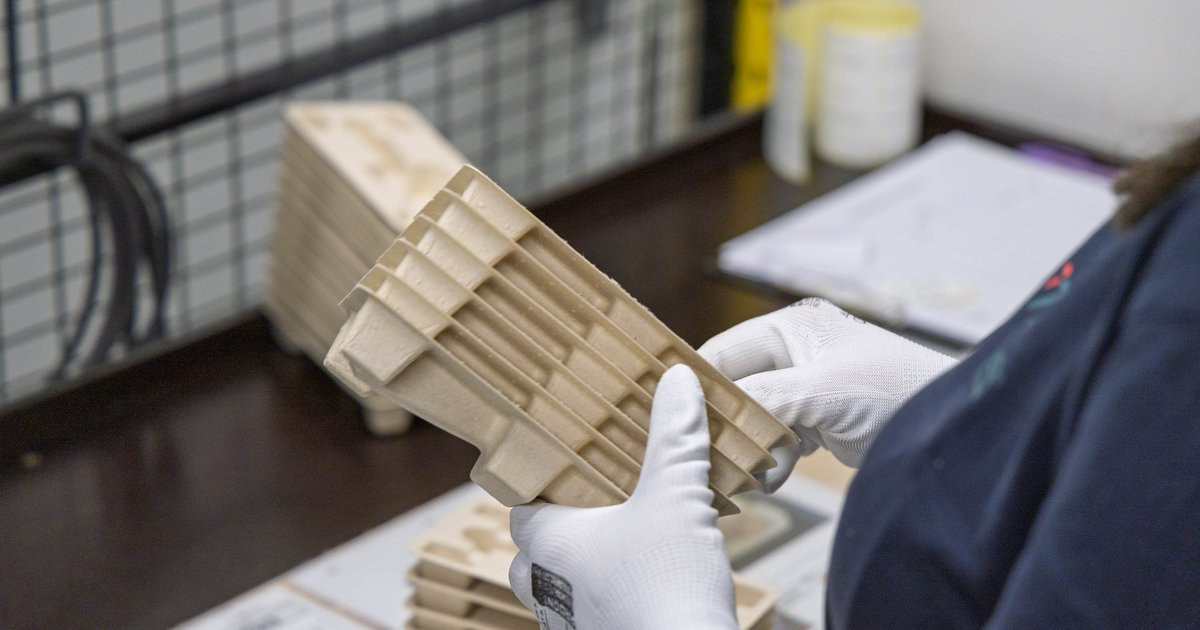
Black molded fibre packaging combines premium aesthetics with functional ESD protection for electronics and audio equipment packaging. Produced using carbon black pigmentation or conductive additives, black molded fibre delivers the dark surface finish that premium consumer electronics brands require whilst meeting electrostatic discharge protection requirements for circuit boards, headphones, speakers, and portable audio devices. European brands moving from plastic clamshells and foam inserts to fibre-based solutions face two technical requirements: achieving consistent black colour without compromising recyclability, and meeting ESD protection thresholds without surface coatings.
Black molded fibre packaging uses carbon black pigment or conductive carbon additives mixed into the pulp slurry before forming. The pigment integrates throughout the fibre matrix rather than sitting as a surface coating, ensuring colour consistency through the full wall thickness. For electronics packaging, this approach delivers two functional benefits: premium dark aesthetics matching brand guidelines, and controlled electrical conductivity preventing electrostatic discharge damage during handling and transport.
Production requires dedicated forming equipment and pulp preparation systems. Carbon black particles remain in suspension throughout the production cycle, requiring separate tanks, forming tools, and drying systems from natural fibre production. TRIDAS operates dedicated black molded fibre production lines launched in 2026, preventing any risk of pigment cross-contamination into food-grade or cosmetics packaging streams that require pristine white or natural fibre appearance.
The wet press molded fibre process produces black packaging with smoother surface finish than dry press technology. In wet press production, the wet pulp pre-form is pressed under heat and pressure simultaneously inside a heated die, compacting fibres into a denser matrix with finer surface detail. This compressed structure accepts carbon black pigment more uniformly, delivering consistent black appearance without the rough texture typical of protective packaging. Wall thickness typically ranges 0.8–2 mm, suitable for inner trays, product cradles, and presentation packaging where surface quality matters.
ESD protection comes from two approaches. Standard carbon black pigmentation at 2–4% by weight provides basic static dissipation in the 10⁹–10¹² ohm range, sufficient for finished goods packaging where components are already encased. For circuit board packaging and component trays requiring stricter ESD control, conductive carbon additives increase to 6–10% by weight, reducing surface resistivity to 10⁶–10⁹ ohms. Both formulations remain fully recyclable under EN 643 grade 1.11.00 (recovered paper and board, mixed grades) provided no plastic films or metal foils are laminated to the surface.
| Property | Black molded fibre (wet press) | Injection-moulded black plastic tray | Die-cut foam insert (ESD) |
|---|---|---|---|
| Surface resistivity (ohms) | 10⁶–10¹² (formulation-dependent) | 10¹⁴–10¹⁶ (insulative without additives) | 10⁴–10⁶ (conductive foam) |
| Lightfastness (ISO 12040) | Grade 6-7 (carbon black) | Grade 7-8 (carbon black in polymer) | Not applicable (foam typically not pigmented) |
| Wall thickness range | 0.8–2 mm typical | 0.5–3 mm typical | 10–50 mm typical |
| Tooling lead time | ~4 weeks (TRIDAS in-house) | 8–12 weeks typical | 2–3 weeks (die cutting) |
| PPWR recyclability target 2030 | ≥70% (fibre-based packaging) | ≥65% (plastic packaging) | ≥65% (plastic packaging) |
| Material density | 0.4–0.6 g/cm³ | 0.9–1.2 g/cm³ | 0.02–0.05 g/cm³ |
Electronics procurement teams evaluating black molded fibre packaging face three decision criteria: aesthetic requirements, ESD protection levels, and regulatory compliance timelines. Premium consumer electronics and audio brands typically specify black packaging to match product colour schemes and reinforce brand positioning. Carbon black pigmentation in molded fibre achieves the dark surface finish these brands require, with lightfastness performance matching injection-moulded plastic trays. The fibre surface texture differs from smooth plastic – wet press technology minimises this difference, but buyers expecting glossy plastic appearance should request samples before committing to tooling.
ESD protection requirements vary by component sensitivity and brand policies. Finished goods packaging for headphones, portable speakers, and audio accessories typically requires static dissipation only – preventing charge build-up during handling without strict surface resistivity limits. Standard carbon black formulations at 2–4% by weight meet these requirements. Circuit board packaging, memory modules, and sensitive electronic components require surface resistivity below 10⁹ ohms, necessitating higher conductive additive loading. Buyers should specify target resistivity ranges during tooling design, as changing carbon loading after production requires new pulp formulation and sample validation.
Regulation (EU) 2025/40 (PPWR) sets ≥70% recyclability targets for fibre-based packaging from 2030, rising to ≥80% from 2038. Black molded fibre meets these thresholds provided no plastic films, foil laminations, or non-fibre coatings are added. Carbon black pigment integrates into paper recycling streams under EN 643 without quality degradation – recycled fibre returns to grey or brown natural colour in subsequent recycling cycles. Buyers currently using black plastic trays or ESD foam inserts face stricter PPWR targets (≥65% for plastics) and higher deposit fees under extended producer responsibility schemes. The material substitution from plastic to black molded fibre reduces compliance risk and fee exposure.
TRIDAS launched dedicated black molded fibre production lines in 2026 to serve electronics and audio packaging applications requiring both premium aesthetics and ESD functionality. Operating separate production equipment for black fibre prevents any cross-contamination risk with natural fibre packaging streams serving cosmetics or food-adjacent applications. TRIDAS designs and manufactures its own molded fibre production lines and operates both wet press and dry press technologies under one roof, enabling technology selection per application – wet press for smooth-surface electronics packaging, dry press for protective applications requiring impact absorption. As an FSC-certified manufacturer sourcing pulp primarily from EU low-risk regions, TRIDAS provides EUDR-compliant Due Diligence Statements per shipment under Regulation (EU) 2023/1115.