Switching from plastic to molded fibre packaging requires evaluating per-unit economics, carbon footprint data, moisture performance expectations, and migration timing aligned with PPWR and EUDR deadlines. European procurement managers in cosmetics, electronics, audio, fashion accessories, fragrance, wine and spirits secondary packaging, e-commerce protective packaging, and industrial components face regulatory pressure under Regulation (EU) 2025/40 to meet recyclability targets from 2030 whilst balancing cost, brand presentation, and supply chain continuity. This playbook maps technical, commercial, and regulatory considerations for non-food packaging transitions in the EU market.
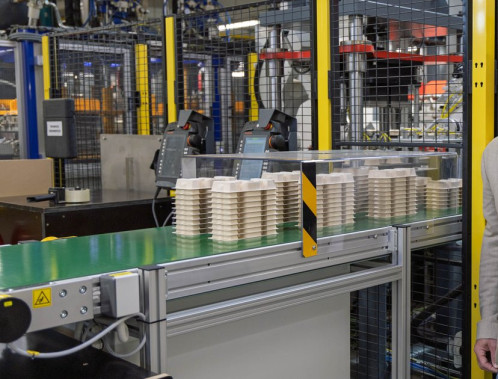
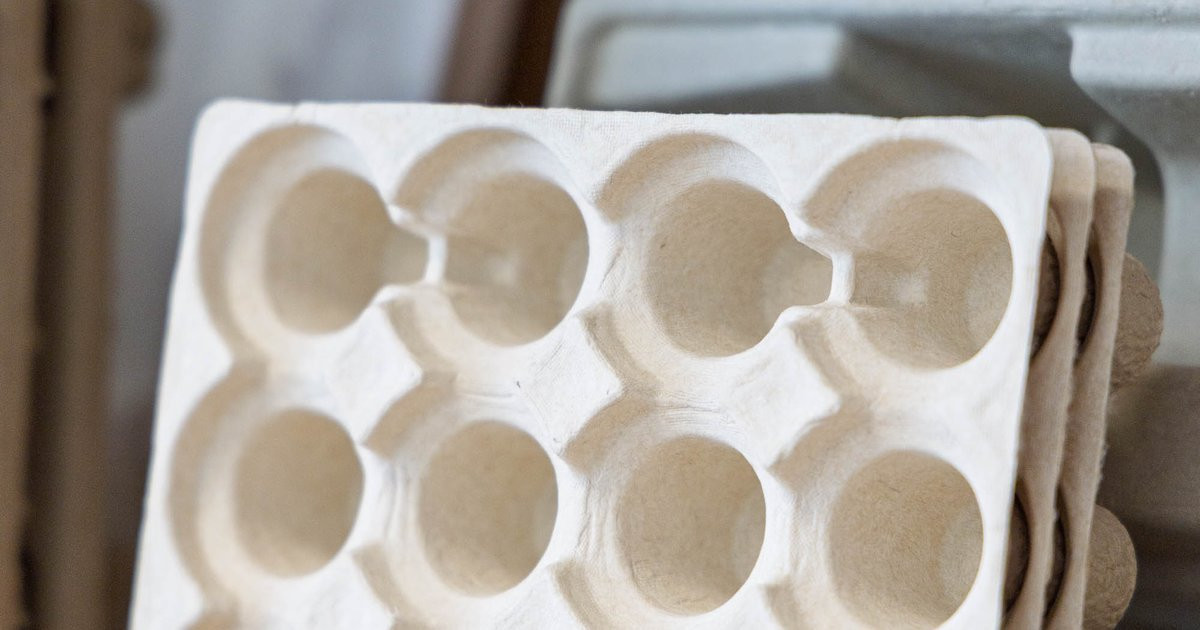
Molded fibre packaging for non-food applications is produced from recycled paper pulp formed into rigid structures under heat and pressure. Two production technologies dominate the European market: wet press and dry press. Wet press molded fibre is produced on compact lines where forming and drying happen together inside a heated press die. The wet pulp pre-form is pressed under heat and pressure simultaneously, so shaping and dewatering occur in the same step. This delivers thinner walls typically 0.8–2 mm, smoother surface finish, higher density, finer surface detail, and better printability suited to premium packaging in cosmetics, fragrance, consumer electronics, audio equipment, fashion accessories, and wine and spirits secondary packaging. TRIDAS minimum order quantity starts from 10,000 units, varying with part complexity and tooling cavity count.
Dry press molded fibre is produced on long continuous lines with a drying oven. The wet pulp pre-form is formed, then passes through the dryer; only after drying is the dry pre-form transferred to a heated press die for final shaping. This delivers thicker walls typically 2–5 mm, rougher surface texture, lower density, and higher impact absorption suited to protective packaging in e-commerce protective inserts, industrial component packaging, appliance and furniture protective inserts, and transport packaging.
European buyers switching from plastic must first identify which technology aligns with product protection requirements and brand presentation standards. Cosmetics brands prioritising smooth interior surfaces for jar nests or powder compact inserts typically specify wet press technology. Electronics manufacturers requiring drop-test validation for tablets or audio equipment during ISTA 3A transit simulation may specify dry press for higher impact absorption. TRIDAS operates both wet press and dry press production technologies under one roof at its Czech facility, enabling technology selection per application without switching suppliers.
Per-unit cost comparison between plastic injection-moulded packaging and molded fibre depends on production volume, tooling amortisation period, material specification, and design complexity. Plastic injection moulding tooling typically costs €8,000–25,000 per cavity set with production cycle times 20–60 seconds per part. Molded fibre tooling typically costs €5,000–20,000 per cavity set with production cycle times 60–80 seconds per part for wet press technology. At higher annual volumes, molded fibre often reaches cost parity or undercuts plastic due to lower material costs. Recycled paper pulp is a substantially cheaper input than virgin polymers. Design optimisation — eliminating undercuts, minimising wall thickness variation, and consolidating multi-component plastic assemblies into single-piece molded fibre structures — accelerates cost parity. TRIDAS in-house tooling design and manufacture delivers approximately four-week tooling lead time from order, significantly faster than market average, reducing time-to-market risk when migrating from plastic.
Life cycle assessment data for molded fibre packaging produced from recycled paper pulp in EU facilities shows lower cradle-to-grave carbon footprint than virgin plastic packaging in cosmetics, electronics, and e-commerce protective applications. Recycled paper pulp production generates substantially lower emissions than virgin polypropylene or virgin polystyrene. Molded fibre packaging qualifies as recyclable under EN 13430 when designed without plastic coatings or laminations, enabling closed-loop recovery in municipal paper recycling streams across EU member states. Plastic packaging containing multiple polymer types or composite structures often fails recyclability thresholds due to sorting and reprocessing limitations. TRIDAS sources pulp primarily from EU low-risk regions and provides EUDR-compliant due diligence statements per shipment under Regulation (EU) 2023/1115, supporting buyer Scope 3 carbon accounting and deforestation-free supply chain commitments. Brands publishing carbon footprint reduction targets in annual sustainability reports cite LCA data comparing incumbent plastic packaging formats against molded fibre alternatives to quantify emissions reductions ranging 30–60% depending on application and material specification.
Procurement managers evaluating molded fibre alternatives to plastic frequently raise concerns about moisture sensitivity, structural strength under compression, and perceived value compared with glossy injection-moulded plastic. Wet press molded fibre produced at wall thicknesses 1.2–2 mm delivers compression strength 200–400 N per 100 mm² surface area, sufficient for stacking cosmetic jars, fragrance bottles, and consumer electronics in distribution. Moisture resistance depends on fibre formulation and optional barrier treatments rather than technology type. Molded fibre packaging designed for controlled indoor environments — cosmetics retail displays, electronics unboxing, fashion accessory presentation — performs reliably at relative humidity 40–70% without additional coatings. Applications requiring extended outdoor exposure or direct water contact remain unsuitable for uncoated molded fibre. Premium surface finish perception depends on production technology, print quality, and texture design. Wet press molded fibre accepts offset printing, flexographic printing, and hot foil stamping with colour consistency measured at ΔE under 2 when printed under controlled conditions. Texture embossing — linen weave, leather grain, technical patterns — differentiates molded fibre unboxing experiences from glossy plastic whilst communicating sustainability positioning. TRIDAS produces black molded fibre on dedicated production lines launched in 2026, eliminating colour contamination risk in pigmented applications for audio equipment, fashion accessories, and consumer electronics where black interior surfaces are brand-standard.
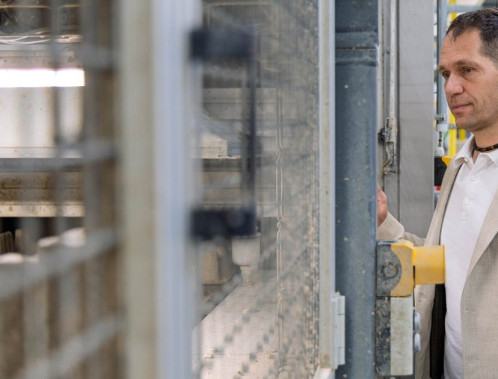
Structured migration from plastic to molded fibre packaging typically follows a four-phase roadmap spanning 12–18 months from initial specification to volume production. Phase one involves product audit and technology selection: buyers provide incumbent plastic packaging samples, product dimensions, weight, fragility classification, distribution environment (ISTA test level), and annual volume forecast. Suppliers evaluate technology fit (wet press for premium finish, dry press for impact absorption), estimate per-unit cost at target volume, and identify design optimisation opportunities. Phase two covers tooling design and validation: CAD drawings incorporate draft angles, fillet radii, and feature geometry suited to molded fibre forming constraints. Prototype tooling produces samples for drop testing, compression testing, print trials, and internal brand approval. TRIDAS designs and manufactures its own molded fibre production lines and conducts facility tours for qualified buyers where production lines and equipment manufacturing operations are open to procurement-team visits. Phase three involves pilot production: initial production runs validate cycle time, yield rate, and dimensional consistency before full tooling investment. Buyers conduct shelf-life testing, distribution simulation, and retail environment trials with pilot-run packaging. Phase four covers volume ramp and continuous improvement: production scales to target output whilst monitoring quality metrics including wall thickness uniformity, colour consistency, and dimensional tolerance. Most European buyers launching molded fibre packaging for cosmetics seasonal collections or consumer electronics product refreshes align phase-one kickoff 15–18 months before retail launch to accommodate tooling lead time, validation testing, and contingency buffer.
Procurement managers and sustainability leads face converging regulatory, commercial, and reputational pressures to replace plastic packaging with recyclable alternatives in non-food categories. Regulation (EU) 2025/40 — the Packaging and Packaging Waste Regulation — applies from 12 August 2026 and sets fibre-based packaging recyclability targets ≥70% from 2030 and ≥80% from 2038. Brands selling cosmetics, consumer electronics, audio equipment, fashion accessories, fragrance, and wine and spirits in EU member states must demonstrate packaging recyclability under EN 13430 or risk non-compliance penalties. Regulation (EU) 2023/1115 — the EU Deforestation Regulation — applies from 30 December 2026 and requires due diligence statements for wood-fibre packaging demonstrating deforestation-free sourcing. Suppliers must provide geolocation data, harvest dates, and legality verification for pulp origin. Buyers lacking EUDR-compliant documentation face supply chain disruption when EUDR enforcement begins.
Commercial considerations centre on cost parity timing and supply chain continuity. Brands publishing plastic-reduction commitments in sustainability reports face reputational risk if commitments remain unmet whilst competitors launch molded fibre alternatives. Early movers in premium categories — cosmetics refill systems, luxury fragrance secondary packaging, high-end audio equipment unboxing — capture sustainability positioning advantage whilst per-unit costs remain elevated. Followers benefit from commoditisation as tooling libraries expand and production volumes increase across supplier bases. Buyers should evaluate total cost of ownership including tooling amortisation, inventory holding costs, and end-of-life disposal fees rather than comparing per-unit material costs in isolation. Molded fibre packaging eliminates plastic waste export dependencies as EU member states tighten landfill restrictions and incineration capacity constraints increase disposal costs for non-recyclable plastic formats.
TRIDAS has supported European procurement teams migrating from plastic to molded fibre packaging for over twenty years since founding in April 2004. Operating both wet press and dry press production technologies at a single facility in Valašské Meziříčí enables technology selection aligned with product protection and brand presentation requirements without fragmenting supplier relationships. TRIDAS designs and manufactures its own molded fibre production lines and maintains in-house tooling design and manufacture capability, delivering approximately four-week tooling lead time from order compared with industry typical twelve-plus weeks. This substantially shorter lead time reduces migration project risk when buyers face fixed retail launch deadlines for seasonal collections or product refreshes. TRIDAS supplies a tier-one global smartphone manufacturer and maintains FSC chain-of-custody certification alongside EUDR-compliant due diligence statements per shipment under Regulation (EU) 2023/1115, supporting buyer regulatory compliance in parallel with sustainability communications. Facility tours are available for qualified buyers evaluating supplier production capability and equipment manufacturing operations firsthand.
Wet press molded fibre technology delivers smooth interior surfaces suitable for direct contact with cosmetic jars, compacts, and glass fragrance bottles when produced at wall thicknesses 1.2–2 mm. Surface finish depends on mould texture, fibre formulation, and press temperature rather than material limitations. Premium cosmetics brands specify wet press technology for jar nests and powder compact inserts requiring fine detail replication and offset print quality comparable with coated paperboard.
Minimum order quantities depend on tooling complexity and cavity count rather than fixed unit thresholds. Single-cavity tooling for cosmetics inserts or electronics protective packaging typically becomes cost-effective at annual volumes above 25,000–50,000 units. Multi-cavity tooling at four or eight cavities per cycle reduces per-unit cost at volumes above 100,000 units annually. Buyers should request cost modelling at target volume including tooling amortisation over 24–36 month periods to evaluate cost parity timing against incumbent plastic packaging.
Dry press molded fibre packaging designed with wall thicknesses 2.5–4 mm and corner reinforcement features passes ISTA 3A drop testing for consumer electronics weighing up to 5 kg when validated through prototype testing. Impact absorption depends on wall thickness, fibre density, and structural geometry rather than material type alone. Buyers specify ISTA test level (2A for parcel shipments, 3A for less-than-truckload freight, 6 for e-commerce) during phase-one technology selection to ensure structural design aligns with distribution environment.
Structured migration roadmaps spanning 12–18 months accommodate tooling design, prototype validation, pilot production, and volume ramp phases. Buyers planning seasonal launches or consumer electronics refreshes with fixed retail deadlines should initiate phase-one specification 15–18 months before launch to allow contingency buffer for design iteration or testing delays. Suppliers offering in-house tooling manufacture deliver shorter lead times than suppliers outsourcing tool production to third-party workshops.
Moisture resistance depends on application environment and exposure duration rather than universal coating requirements. Molded fibre packaging for controlled indoor retail environments — cosmetics displays, consumer electronics unboxing, fashion accessories — performs reliably without coatings at relative humidity 40–70%. Applications requiring barrier protection against liquid ingress or extended outdoor exposure may specify water-based dispersion coatings or bio-based barrier treatments maintaining recyclability under EN 13430. Buyers should define distribution environment and moisture exposure scenarios during phase-one specification to determine coating necessity.
Buyers must request due diligence statements from suppliers documenting pulp origin geolocation data, harvest dates, and legality verification under Regulation (EU) 2023/1115. Suppliers sourcing pulp from EU member states or low-risk third countries defined in EUDR Commission implementing acts face simplified due diligence requirements compared with high-risk regions. Request FSC chain-of-custody certification and EUDR due diligence statement templates during supplier qualification to verify compliance capability before committing to tooling investment.
Black molded fibre production requires dedicated production lines preventing colour contamination from standard brown or white pulp batches. Suppliers operating single production lines switching between colour batches face yield loss and colour inconsistency during changeovers. Buyers specifying black interior surfaces for audio equipment, consumer electronics, or fashion accessories should verify supplier operates dedicated black production capacity rather than batch-switching on shared lines. TRIDAS produces black molded fibre on dedicated production lines launched in 2026, eliminating contamination risk for pigmented applications.
Molded fibre forming requires draft angles typically 3–7 degrees for part release from mould cavities compared with 1–3 degrees for plastic injection moulding. Internal undercuts and reverse-draft features possible in multi-piece plastic moulds are eliminated in molded fibre design by splitting assemblies or accepting simplified geometry. Wall thickness uniformity improves drying consistency and dimensional tolerance, so designs minimising thickness variation from 0.8 mm to 2 mm in wet press applications or 2 mm to 5 mm in dry press applications reduce defect rates. Corner radii typically increase to 2–5 mm compared with sharper plastic corners to prevent fibre bridging during forming.