08. 26. 2026
Molded fibre packaging typically costs 15–40% more per unit than equivalent polypropylene or polystyrene packaging at lower production volumes, driven by recycled paper pulp being a substantially cheaper raw material input than virgin polymers, offset by differences in part weight and density requirements, alongside lower tooling investment (€5,000–20,000 per cavity set vs €8,000–25,000 for plastic injection moulding). Break-even occurs when PPWR compliance costs, brand positioning benefits, and end-of-life disposal savings offset the material premium—typically at higher annual volumes for brands targeting premium non-food categories including cosmetics, consumer electronics, and wine secondary packaging.
The fundamental cost structure for molded fibre and plastic packaging diverges at three points: raw material pricing, tooling capital expenditure, and production cycle efficiency. Recycled paper pulp is a substantially cheaper raw material input than virgin polymers, reflecting lower energy intensity in mechanical pulping and recycling infrastructure maturity. Material cost per unit depends on part weight—a 50-gram molded fibre component uses €0.02–0.03 material; an equivalent 30-gram polypropylene part uses €0.04–0.05 material.
Tooling economics favour molded fibre at lower production volumes. A single-cavity molded fibre tooling set costs €5,000–20,000 at TRIDAS, with lead times approximately 4 weeks—substantially faster than typical injection-moulding tooling lead times. Plastic injection moulding tooling ranges €8,000–25,000 per cavity set, with 6–10 week lead times common among EU suppliers. Tooling amortisation at higher annual volumes reduces unit cost for both technologies. Multi-cavity tooling shifts this equation: plastic injection moulding scales efficiently to 4-cavity and 8-cavity configurations, while molded fibre typically uses 2-cavity or 4-cavity layouts due to forming pressure distribution constraints.
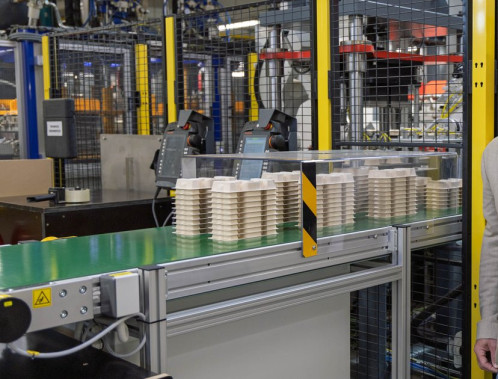
Production cycle times determine labour and overhead allocation. TRIDAS wet press molded fibre achieves 8–20 second cycles per part on automated lines; industrial dry press molded fibre runs 3–8 second cycles. Plastic injection moulding cycles range 20–60 seconds depending on wall thickness and cooling requirements. Faster cycles reduce per-unit overhead, but must be weighed against material density differences: molded fibre density sits at 0.3–0.8 g/cm³, requiring thicker walls (wet press 0.8–2 mm, dry press 2–5 mm) to achieve equivalent structural performance compared to polypropylene at 0.9 g/cm³ and polystyrene at 1.0–1.2 g/cm³. Part weight drives material cost per unit more than cycle time drives labour cost in automated facilities.
Energy consumption per unit favours molded fibre in wet press configurations where forming and drying occur simultaneously under heated press conditions (160–220°C, 15–45 second duration). Dry press molded fibre requires separate drying ovens (180–250°C, 3–8 minute duration), increasing energy cost per unit. Plastic injection moulding maintains heated barrels and moulds continuously, but cooling cycle energy remains lower than molded fibre drying energy on a per-unit basis at high volumes.
| Annual volume | Molded fibre cost per unit | Plastic cost per unit | Molded fibre premium | Break-even factors |
|---|---|---|---|---|
| 50,000 units | €0.35–0.55 | €0.25–0.35 | +40–57% | Tooling amortisation dominates at lower volumes; plastic advantage clear |
| 100,000 units | €0.28–0.42 | €0.20–0.30 | +30–40% | Material cost becomes primary factor at moderate volumes; brand positioning value offsets premium in cosmetics |
| 200,000 units | €0.22–0.35 | €0.18–0.25 | +15–30% | PPWR compliance costs (extended producer responsibility fees) narrow gap at moderate to higher volumes; disposal cost savings material |
| 500,000 units | €0.18–0.28 | €0.15–0.22 | +15–27% | Multi-cavity tooling deployed both technologies at higher volumes; lifecycle cost (LCA carbon cost under CBAM) favours molded fibre |
| 1,000,000 units | €0.15–0.24 | €0.13–0.20 | +15–20% | Procurement negotiation power equalises material pricing at scale; end-of-life infrastructure cost (municipal waste vs packaging recovery) tips total cost equation toward molded fibre |
PPWR Regulation (EU) 2025/40 applies from 12 August 2026, imposing fibre-based packaging recyclability targets of 70% from 2030 and 80% from 2038. Brands using non-recyclable plastic packaging face extended producer responsibility fee increases estimated at 15–35% across EU member states implementing national packaging recovery schemes. This shifts the total cost calculation: a €0.25 plastic packaging unit with 20% EPR fee uplift becomes €0.30 effective cost, narrowing the gap against €0.35 molded fibre at moderate annual volumes. Disposal cost differences compound over product lifecycle—municipal waste collection fees for non-recyclable plastic packaging are substantially higher than paper-fibre packaging, which enters established recovery streams at lower gate fees.
Brand positioning value in premium non-food categories justifies per-unit premiums where packaging communicates sustainability credentials directly to end consumers. Cosmetics brands report willingness to absorb 25–40% packaging cost increases when molded fibre packaging supports premium shelf presence and aligns with clean-beauty positioning. Consumer electronics manufacturers cite similar thresholds where unboxing experience and secondary packaging sustainability messaging justify molded fibre adoption despite higher per-unit cost. Wine and spirits secondary packaging operates under tighter margin constraints, but premiumisation trends in €30+ bottle segments create space for molded fibre economics at moderate to higher annual volumes.
Carbon cost accounting under the EU Carbon Border Adjustment Mechanism influences procurement decisions for brands with science-based emissions reduction targets. Lifecycle assessment data shows recycled paper pulp emits 0.4–0.6 kg CO₂e per kg cradle-to-gate vs 1.9–2.3 kg CO₂e for virgin polypropylene. At current EU ETS prices, this carbon differential adds notional cost favouring molded fibre, though CBAM application to packaging remains under regulatory development. Procurement teams building 2027–2030 packaging roadmaps must model CBAM scenarios where carbon-intensity penalties shift plastic packaging economics unfavourably relative to fibre-based alternatives.
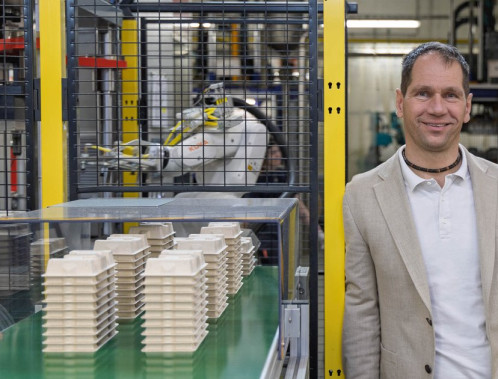
TRIDAS designs and manufactures its own molded fibre production lines, enabling tooling lead times approximately 4 weeks from order—substantially faster than alternative molded fibre suppliers operating 4–8 week schedules. Faster tooling reduces time-to-market cost and allows procurement teams to test molded fibre economics at lower initial volumes before committing to multi-cavity tooling investments. TRIDAS operates both wet press and dry press production technologies under one roof, supporting cost optimisation per application: wet press for premium cosmetics and consumer electronics packaging where surface finish justifies higher per-unit cost; dry press for protective packaging where impact absorption and cost efficiency drive technology selection. Supplying a tier-one global smartphone manufacturer, TRIDAS validates production economics at volumes where molded fibre cost competitiveness depends on precise cycle-time control and material yield optimisation.