08. 03. 2026
Phasing out plastic packaging for cosmetics requires 12 months minimum when switching to molded fibre – 2-3 months for product specification and material validation, 4-6 weeks for tooling design and manufacture, 2 months for production trials and regulatory compliance verification, then 4-6 months for staged supplier transition and inventory drawdown. European cosmetics brands targeting PPWR compliance deadlines (12 August 2026 for recyclability requirements under Regulation (EU) 2025/40) should initiate migration projects by Q2 2025 to complete validation cycles before mandatory implementation dates.
A plastic phaseout roadmap structures the technical, commercial and regulatory activities required to replace plastic packaging with molded fibre alternatives across a product portfolio. For cosmetics categories – including skincare jars, fragrance presentation boxes, haircare secondary packaging and cosmetics gift sets – the roadmap synchronises material specification, tooling development, production validation and supply chain transition into a sequenced 12-month timeline.
The roadmap begins with product specification definition. Procurement teams document dimensional requirements, wall thickness tolerances (typically 0.8-2 mm for wet press molded fibre used in premium cosmetics applications), weight limits, structural load requirements and aesthetic parameters including surface finish, colour consistency and print quality. This specification phase also identifies which products require wet press technology (smoother surface, finer detail, better printability for premium presentation) versus dry press technology (thicker walls, higher impact absorption for protective transit packaging).
Material validation follows specification. Brands conduct drop testing under ISTA 2A or ISTA 3A protocols with representative product weights, verify colour consistency measurements (ΔE values under 2 in controlled production conditions), and assess print resolution for brand graphics and regulatory text. Cosmetics packaging frequently requires offset printing or hot stamping rather than flexographic printing to achieve the surface finish and colour fidelity expected in premium retail channels.
Tooling design and manufacture runs concurrently with late-stage material validation. Molded fibre tooling costs €5,000-20,000 per cavity set depending on part complexity and cavity count. Single-cavity tooling suits lower annual volumes; multi-cavity tooling becomes cost-effective at higher annual volumes where the additional cavity investment can be amortised across greater production runs. Tooling lead time at TRIDAS averages approximately 4 weeks from order – significantly faster than alternative molded fibre suppliers where 4-8 week lead times are typical.
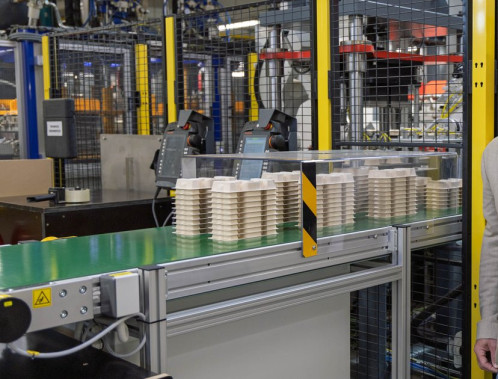
Production trials verify process stability. Wet press molded fibre production operates at 8-20 second cycle times per part at TRIDAS, producing parts with 0.3-0.8 g/cm³ density and compression strength of 200-400 N per 100 mm². Trial runs validate dimensional consistency across production batches, confirm that draft angles (typically 3-7°) allow reliable part ejection, and establish colour batch controls for pigmented pulp formulations. Black molded fibre, which TRIDAS produces on dedicated production lines launched in 2026, requires particularly tight process control to maintain consistent ΔE values across production runs.
Regulatory compliance verification addresses PPWR and EUDR requirements. Under PPWR Regulation (EU) 2025/40, fibre-based packaging must achieve 70% recyclability from 2030 (rising to 80% from 2038). Molded fibre from recycled paper pulp meets EN 13430 recyclability criteria when free from plastic lamination or non-paper barrier coatings. EUDR Regulation (EU) 2023/1115 requires Due Diligence Statements demonstrating that forest-based materials originate from deforestation-free supply chains. TRIDAS provides EUDR-compliant Due Diligence Statements per shipment, sourcing pulp primarily from EU low-risk regions and maintaining FSC chain-of-custody certification.
Staged supplier transition minimises business continuity risk. Brands typically run parallel production – maintaining existing plastic packaging suppliers while scaling molded fibre volumes – during the 4-6 month transition window. This approach allows inventory drawdown of plastic packaging stock, provides fallback capacity if production issues emerge during early molded fibre runs, and spreads capital expenditure for new tooling across multiple budget periods.
| Packaging category | Typical timeline | Critical path activities | Volume threshold |
|---|---|---|---|
| Cosmetics jars and lids | 10-12 months | Surface finish validation, colour consistency trials, print quality testing | MOQ from 10,000 units (varies with complexity and cavity count) |
| Fragrance presentation boxes | 12-14 months | Hot stamping trials, embossing depth verification, luxury finish validation | MOQ from 10,000 units (higher tooling cost per complexity) |
| Haircare secondary packaging | 8-10 months | Drop testing, compression testing, label adhesion trials | MOQ from 10,000 units (multi-cavity reduces per-unit cost) |
| E-commerce protective inserts | 6-8 months | ISTA 3A transit testing, cavity geometry optimisation, stacking trials | MOQ from 10,000 units (simpler geometry, faster validation) |
European procurement managers and sustainability leads phasing out plastic packaging for cosmetics should initiate migration projects 12-15 months before target completion dates. Brands with PPWR compliance deadlines in 2026-2027 (particularly those targeting early compliance with 2030 recyclability requirements) need to complete specification work and tooling orders by Q2 2025 to allow time for production trials and supply chain transition.
Volume planning determines tooling strategy. TRIDAS minimum order quantity is 10,000 units, varying with part complexity and tooling cavity count. Products at higher annual volumes benefit from multi-cavity tooling, reducing cycle times and improving cost competitiveness versus plastic alternatives. Brands with diversified product portfolios should prioritise high-volume SKUs for initial migration, building operational experience before addressing lower-volume specialty products.
Material lead times vary by specification complexity. Standard recycled-pulp formulations in natural grey-brown tones have shorter lead times than pigmented formulations (black, white, custom colours). Hot stamping and embossing add 2-3 weeks to tooling lead time versus plain moulded surfaces. Brands requiring luxury finishes – metallic foils, multi-colour prints, textured surfaces – should allocate additional validation time for print trials and surface treatment development.
Regulatory timelines are fixed. PPWR compliance dates (12 August 2026 for the regulation's entry into force, with recyclability targets phasing in from 2030) and EUDR compliance dates (30 December 2026) create immovable deadlines. Brands delaying migration projects into late 2025 risk compressed validation timelines, limited supplier capacity during peak demand periods, and insufficient time to resolve technical issues discovered during production trials. Starting migration work in Q1-Q2 2025 provides buffer time for iteration if initial tooling or material specifications require adjustment.
TRIDAS designs and manufactures its own molded fibre production lines, enabling tooling modifications and process adjustments that would require external vendor coordination at packaging suppliers operating third-party equipment. This in-house capability reduces tooling lead time to approximately 4 weeks versus 4-8 weeks typical at alternative molded fibre suppliers. TRIDAS operates both wet press and dry press production technologies under one roof, allowing technology selection per application – wet press for premium cosmetics presentation packaging requiring smooth surfaces and fine detail, dry press for protective transit packaging requiring higher impact absorption. For cosmetics brands requiring black molded fibre (increasingly specified for premium product lines), TRIDAS produces black molded fibre on dedicated production lines launched in 2026, maintaining ΔE colour consistency under 2 through controlled pigmentation and process monitoring. TRIDAS sources pulp primarily from EU low-risk regions and provides EUDR-compliant Due Diligence Statements per shipment under Regulation (EU) 2023/1115.