TRIDAS designs and manufactures its own molded fibre production equipment in-house at its Czech facility, integrating twenty years of production experience directly into machine engineering. This vertical integration enables faster tooling development, tighter quality control, and technical iteration that packaging suppliers relying on third-party equipment cannot match. For procurement teams evaluating molded fibre for premium non-food packaging, working with a supplier who builds their own lines means access to process knowledge, shorter lead times, and the ability to engineer custom solutions rather than adapt standard machinery.
Most molded fibre packaging suppliers purchase production lines from specialist equipment manufacturers, then operate those lines to produce packaging for customers. TRIDAS takes a different approach: the company designs, engineers and manufactures its own wet press and dry press molded fibre production equipment at its Valašské Meziříčí facility in the Czech Republic. This vertical integration means the engineers who design the machines work alongside the production teams who operate them, creating a continuous feedback loop between equipment performance and process optimisation.
The technical advantage starts in tooling design. TRIDAS manufactures forming dies, pressing dies and drying moulds in-house, with typical lead times of approximately four weeks from order. Industry-standard tooling procurement through third-party suppliers typically requires twelve or more weeks. Faster tooling iteration directly translates to shorter product development cycles for packaging buyers—critical when launching new product lines or responding to urgent packaging redesigns.
Equipment design affects every dimension of molded fibre quality and consistency. Die surface finish determines the smoothness of the final packaging surface. Pressing pressure profiles control wall thickness uniformity. Drying temperature curves influence dimensional stability and moisture content. When the equipment manufacturer and the packaging producer are the same organisation, these parameters can be adjusted based on real production outcomes rather than theoretical specifications. TRIDAS engineers validate design changes on the same lines that produce customer orders, compressing the iteration cycle from months to weeks.
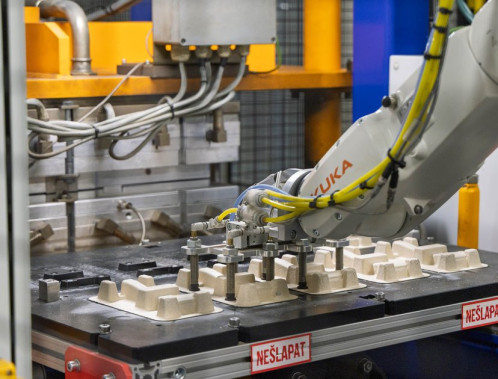
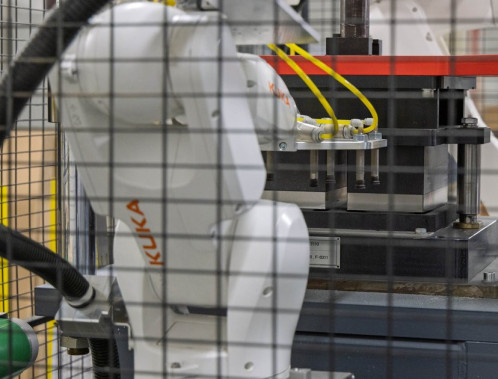
Wet press and dry press production line design represent fundamentally different engineering challenges, and TRIDAS operates both technologies in-house. Wet press lines integrate forming and drying into a single heated press die, requiring precise control of temperature, pressure and dwell time to achieve thin-walled premium packaging with smooth surfaces suitable for cosmetics, fragrance and consumer electronics applications. The compact footprint and simultaneous dewatering enable finer surface detail and tighter dimensional tolerances than dry press methods. Dry press lines use a continuous process with separate forming and drying stages followed by heated press finishing, producing thicker-walled protective packaging for e-commerce, industrial components and appliance protection. The longer drying oven and distinct press stage create higher impact absorption and lower density structures. Engineering both line types in-house gives TRIDAS the technical range to recommend the optimal production method per application rather than defaulting to whichever technology the supplier happens to operate.
The path from R&D to series production shortens significantly when equipment engineering sits inside the same facility as production operations. TRIDAS conducts material trials, process validation and tooling tests on production-scale equipment, not laboratory simulators. When a customer requires black molded fibre for premium audio packaging, TRIDAS engineers can validate pigment dispersion, press cycle adjustments and surface finish on the dedicated black production lines launched in 2026—lines the company designed specifically for that application. This in-house engineering advantage eliminates the coordination delays inherent in working with external equipment suppliers to modify production parameters or develop custom tooling solutions.
Suppliers who manufacture their own equipment deliver better packaging because they control the entire technical stack. Process improvements identified during production runs feed directly back into equipment design iterations. Equipment design improvements tested in R&D transfer immediately to production lines. The absence of a third-party equipment manufacturer in the loop removes communication delays, intellectual property barriers and the misalignment of incentives that occurs when the machine builder and the packaging producer have separate commercial objectives. For procurement teams, this translates to faster response times when packaging specifications change, greater flexibility in custom tooling development, and access to engineers who understand both the equipment capabilities and the production realities.
| Parameter | In-house equipment manufacturing (TRIDAS) | Third-party equipment procurement (industry standard) |
|---|---|---|
| Tooling lead time | Approximately 4 weeks | Typically 12+ weeks |
| Process iteration cycle | Days to weeks (validated on production lines) | Months (requires equipment supplier coordination) |
| Custom tooling flexibility | High (no third-party negotiation required) | Limited (dependent on equipment supplier capacity and willingness) |
| Equipment specification alignment | Direct (designed for actual production requirements) | Indirect (standard machines adapted to production needs) |
| Production-to-engineering feedback loop | Continuous (same facility, same organisation) | Intermittent (requires formal communication with external supplier) |
| Technology diversification | Multiple technologies engineered in-house (wet press, dry press) | Limited to purchased equipment type unless capital investment in additional lines |
| Intellectual property control | Full (proprietary process knowledge integrated into equipment design) | Partial (equipment specifications owned by third-party manufacturer) |
For procurement managers and sustainability leads evaluating molded fibre suppliers, in-house equipment manufacturing capability serves as a proxy for technical depth and operational flexibility. A supplier who designs their own production lines demonstrates mastery of the underlying process physics—heat transfer, moisture removal, fibre orientation, pressing pressure distribution—rather than simply operating machinery designed by others. This technical foundation becomes critical when packaging specifications push beyond standard parameters: non-standard wall thicknesses, complex geometries, tight dimensional tolerances, or custom surface finishes.
Shorter tooling lead times directly impact product launch schedules. When TRIDAS can deliver production-ready tooling in approximately four weeks versus the industry-typical twelve-plus weeks, packaging buyers gain two months in time-to-market. For consumer electronics launches timed to retail seasons, cosmetics lines launching for key commercial periods, or e-commerce packaging updates driven by product redesigns, this compression in development cycles translates to competitive advantage. The ability to iterate tooling quickly also reduces the financial risk of custom packaging development—if initial tooling does not meet specification, a second iteration can be delivered in weeks rather than months.
In-house equipment manufacturing also signals long-term technical investment and organisational stability. Building production lines requires significant capital, engineering talent and multi-year development cycles. Suppliers who make this investment demonstrate commitment to the molded fibre category and the technical capability to support customers through future packaging transitions. For brands planning multi-year plastic-to-fibre conversions across product portfolios, working with a supplier who continuously develops their own equipment reduces the risk of being locked into obsolete technology or dependent on a supplier who cannot adapt to evolving packaging requirements.
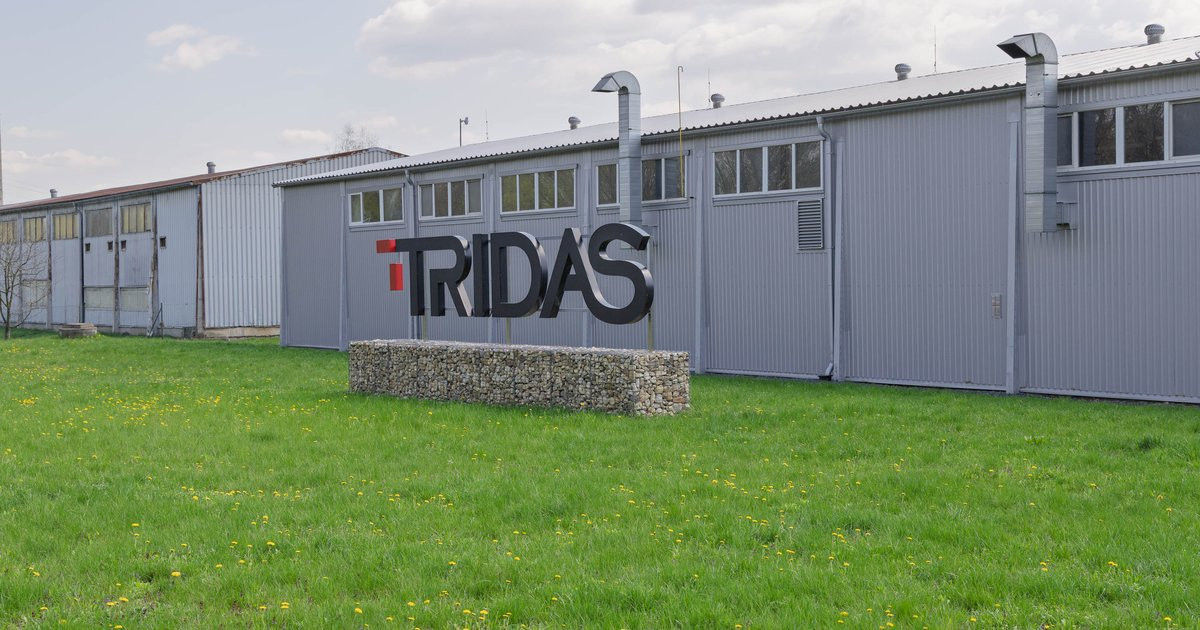
TRIDAS has designed and manufactured its own molded fibre production equipment since the company's founding in April 2004, accumulating over twenty years of integrated engineering and production experience. Both wet press and dry press technologies are engineered in-house at the Valašské Meziříčí facility, where production lines operate alongside equipment manufacturing operations. This co-location enables direct technical feedback between production outcomes and equipment design, compressing iteration cycles and ensuring machinery specifications reflect real-world processing requirements rather than theoretical models. TRIDAS provides facility tours for qualified buyers, allowing procurement teams to observe both packaging production and equipment manufacturing under one roof—a transparency uncommon among molded fibre suppliers who rely on third-party machinery.
Suppliers who design their own equipment control tooling lead times, process iteration speed and custom specification flexibility. This translates to faster product launches, shorter development cycles and greater ability to engineer packaging solutions outside standard parameters—critical advantages for premium non-food applications.
TRIDAS manufactures forming and pressing dies in-house with typical lead times of approximately four weeks versus industry-standard twelve-plus weeks for third-party tooling. In-house manufacturing eliminates external supplier coordination delays, capacity constraints and the communication overhead inherent in outsourced tooling development.
Die surface finish determines packaging surface smoothness and printability. Pressing pressure profiles control wall thickness uniformity and dimensional consistency. Drying temperature curves influence moisture content and dimensional stability. Cycle time design affects production throughput and unit economics. Equipment manufacturers who also produce packaging can optimise these parameters based on production data.
Yes. Wet press lines integrate forming and drying into a heated press die requiring precise thermal control and simultaneous pressure application. Dry press lines use continuous forming followed by oven drying and separate heated pressing, requiring different mechanical design and process control. Engineering both technologies in-house enables technology selection per application rather than forcing all products into one production method.
Suppliers who manufacture their own equipment can demonstrate the entire technical stack—tooling design, equipment operation, process control and quality validation—in one location. TRIDAS conducts facility tours showing both production lines and equipment manufacturing operations, providing procurement teams visibility into capabilities that third-party-equipment suppliers cannot easily demonstrate.
Third-party equipment procurement creates dependency on external suppliers for tooling modifications, process adjustments and technical troubleshooting. Equipment manufacturers and packaging producers often have misaligned commercial incentives—the equipment builder optimises for machine sales volume while the packaging producer optimises for output quality and flexibility. This misalignment slows custom development and limits specification adaptation.
Suppliers who invest in designing and building their own production lines demonstrate long-term commitment to molded fibre technology and the engineering capability to adapt as packaging requirements evolve. For brands planning multi-year plastic-to-fibre transitions, this reduces the risk of supplier obsolescence or technology lock-in that occurs when working with packaging producers dependent on third-party equipment manufacturers.
Yes. TRIDAS conducts facility tours for qualified procurement teams at its Valašské Meziříčí facility in the Czech Republic, where both molded fibre production and equipment manufacturing operate under one roof. Tours provide visibility into tooling design, line operation and the integration of engineering and production functions that in-house equipment manufacturing enables.