10. 26. 2026
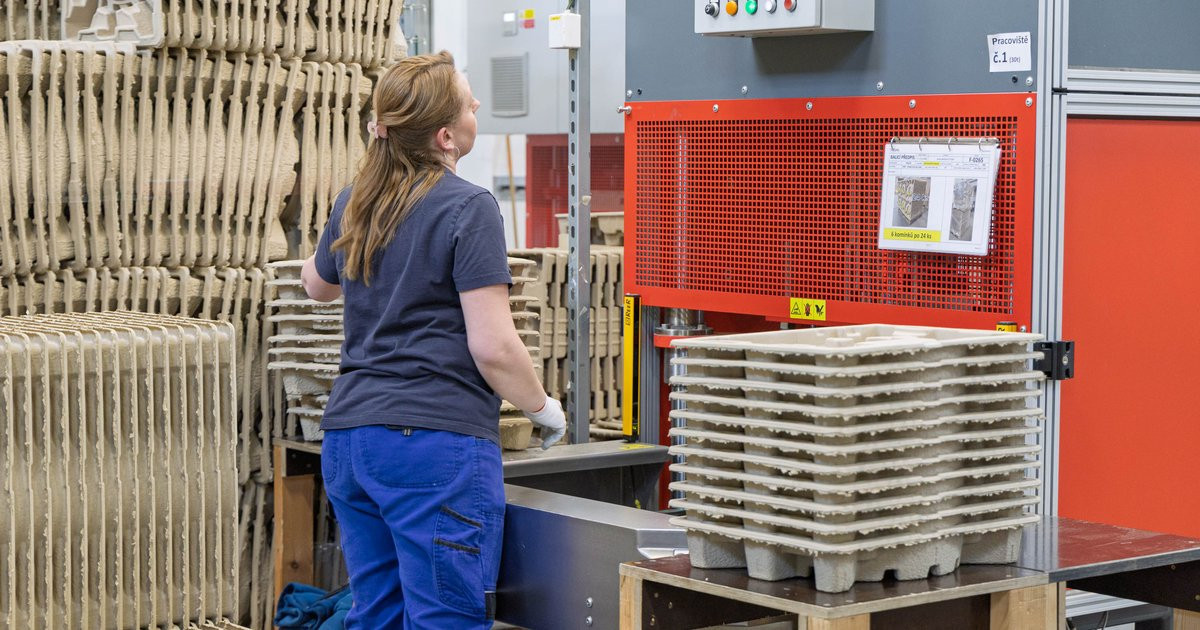
TRIDAS operates R&D, tooling design, production equipment manufacturing, and series production under one roof at its Czech facility, enabling direct knowledge transfer from prototype validation to full-scale manufacturing. This integrated structure shortens development cycles, reduces supplier coordination overhead, and allows real-time production-line modifications based on buyer feedback — capabilities unavailable when packaging suppliers and equipment manufacturers operate as separate entities.
Most molded fibre packaging suppliers purchase production equipment from external machinery manufacturers, creating a structural separation between the design of the production line and the design of the packaging itself. TRIDAS eliminates this separation by operating as both a packaging supplier and a production equipment designer-manufacturer. Engineers who develop tooling concepts work in the same facility as technicians who maintain production lines and operators who run series production. This physical and organisational integration creates direct feedback loops unavailable in traditional supplier models.
The engineering workflow begins when a buyer submits technical drawings or physical samples. TRIDAS R&D engineers assess feasibility across both wet press and dry press technologies, selecting the production method based on required wall thickness, surface finish, and structural performance specifications. Tooling designers then create cavity geometries in CAD, incorporating draft angles (typically 3–7°), drainage patterns, and embossing or debossing features as specified. Tooling manufacture occurs in the on-site workshop, where CNC machining centres and manual finishing stations produce aluminium forming dies and steel press dies. Typical tooling lead time is approximately 4 weeks from order confirmation — significantly faster than alternative molded fibre suppliers, whose 4–8 week lead times reflect dependency on external tooling workshops.
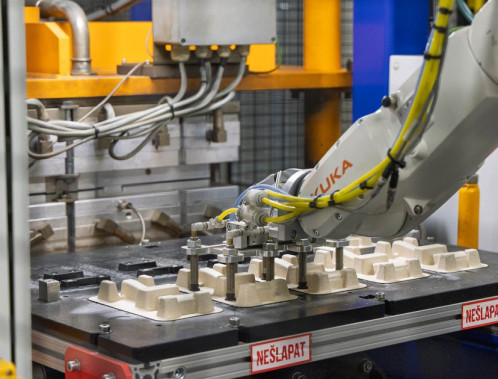
Once tooling is installed on production lines, process engineers conduct trial runs to validate cycle times, wall thickness uniformity, and dimensional tolerances. Because the production equipment itself was designed and built in-house, line modifications — such as adjusting suction timing, recalibrating press pressure profiles, or modifying drying oven temperature zones — are executed by the same engineering team that designed the equipment. This eliminates the coordination overhead, vendor approval delays, and confidentiality barriers typical when equipment suppliers and packaging suppliers operate as separate commercial entities.
TRIDAS operates both wet press production lines (for thinner-walled premium packaging) and dry press production lines (for thicker-walled protective packaging) within the single Valašské Meziříčí facility. Engineering knowledge transfers directly between technology platforms: lessons from wet press cycle-time optimisation inform dry press oven-temperature profiling; material-drainage insights from dry press forming improve wet press cavity design. This cross-technology learning is structurally impossible when a packaging supplier sources equipment from multiple external vendors using proprietary control systems.
| Dimension | TRIDAS in-house model | Typical outsourced equipment model |
|---|---|---|
| Tooling lead time | ~4 weeks from order | 4–8 weeks (external workshop dependency) |
| Line modification speed | Real-time (same engineering team) | Requires vendor coordination and approval |
| Technology selection | Wet press and dry press under unified engineering control | Limited by purchased equipment capabilities |
| Process IP ownership | Full ownership of equipment design and process parameters | Shared or vendor-controlled process parameters |
| Facility transparency | Equipment manufacturing visible during production facility tours | Equipment sourcing opaque to buyer |
For procurement managers evaluating molded fibre suppliers, the in-house engineering model reduces three categories of supply-chain risk: tooling lead-time variability, production-line downtime, and supplier lock-in. When tooling manufacture depends on external workshops, lead times fluctuate based on workshop capacity, material availability, and coordination delays between packaging supplier and tooling vendor. TRIDAS tooling production occurs within the same facility as series production, removing external dependencies that introduce schedule variability. Buyers receive consistent 4-week tooling lead times regardless of broader market conditions affecting external tooling suppliers.
Production-line modifications — required when buyers request design changes after initial tooling validation, or when regulatory requirements shift mid-contract — become simpler coordination exercises when equipment design, tooling design, and production operations report to unified management. A request to adjust press temperature profiles, modify suction timing, or recalibrate forming-die drainage requires no vendor negotiation, no confidentiality agreements with third-party equipment suppliers, and no competitive-bid processes for line modifications. Engineering changes are executed as internal facility operations rather than external supplier engagements.
The dual capability — operating as both packaging supplier and equipment manufacturer — also reduces supplier lock-in risk. When a molded fibre packaging supplier depends entirely on external equipment vendors, buyers inherit hidden dependencies on those vendors' proprietary control systems, spare-part availability, and willingness to support legacy equipment generations. TRIDAS owns complete equipment design documentation, manufactures its own spare parts, and maintains engineering knowledge of every production line in operation. If a buyer later requires production capacity expansion, line relocation, or technology transfer, the equipment documentation and process parameters are internally controlled rather than subject to third-party licensing negotiations.
Facility tours provide visible validation of this integrated structure. Buyers visiting TRIDAS see tooling manufacture, equipment assembly, wet press production, and dry press production within a single facility walk. This transparency allows procurement teams to verify engineering capabilities directly rather than relying on supplier claims about "close partnerships" with equipment vendors — partnerships that may shift when vendors prioritise alternative clients or exit the molded fibre equipment market entirely.
TRIDAS has operated as an integrated equipment manufacturer and packaging supplier since its founding in 2004, accumulating over 20 years of engineering knowledge across both wet press and dry press molded fibre technologies. The company designs and manufactures its own production lines at its Valašské Meziříčí facility, where R&D, tooling design, equipment manufacturing, and series production share unified management and physical space. This structure emerged not as a strategic differentiation exercise but as a practical response to early limitations in commercially available molded fibre equipment — limitations that required in-house engineering solutions to meet buyer specifications for premium non-food packaging applications. The resulting organisational model now serves as the foundation for TRIDAS's approach to new product development, tooling lead-time commitments, and production-line scalability discussions with European procurement teams.