08. 24. 2026
Wet press and dry press molded fibre production lines differ fundamentally in architecture, footprint and process sequence. Wet press lines combine forming and drying in a single heated press die, producing thin-walled parts with smooth surfaces in compact equipment configurations. Dry press lines separate forming from drying across a long continuous conveyor, producing thicker-walled protective packaging with higher impact absorption. Understanding these architectural differences determines equipment investment, facility layout requirements and achievable part specifications for non-food packaging applications.
Molded fibre production line design governs part quality, production economics and facility integration for manufacturers moving packaging production in-house or sourcing from contract suppliers. The architectural distinction between wet press and dry press systems stems from where and how water removal occurs during the production cycle.
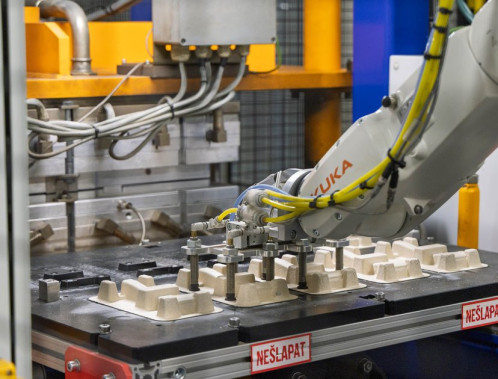
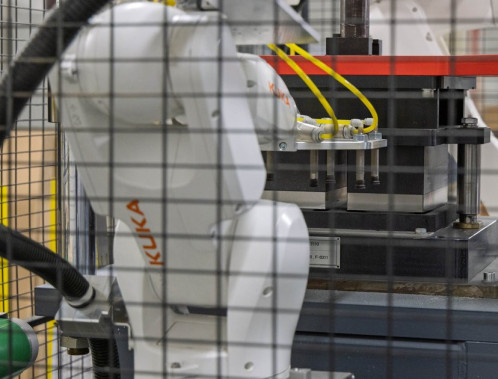
Wet press lines follow a compact sequential architecture: pulp mixing, vacuum forming, heated press drying and ejection occur within a single integrated equipment footprint. The wet pulp pre-form transfers directly from the forming station into a heated press die operating at 160–220°C and 20–60 bar pressure. Forming and dewatering happen simultaneously under heat and pressure, eliminating the need for separate drying equipment. The pressed part emerges dry and ready for ejection after 15–45 seconds in the die. This integrated process produces thin walls (0.8–2 mm), smooth surfaces and fine detail resolution suitable for premium cosmetics, fragrance, consumer electronics and audio equipment packaging.
Dry press lines distribute the production process across a long continuous conveyor system. Pulp mixing and vacuum forming occur at the line head. The wet pre-form then travels through a drying oven operating at 180–250°C for 3–8 minutes, removing most moisture before the part reaches the press station. Only after drying does the rigid pre-form transfer into a heated press die for final shaping. This two-stage architecture produces thicker walls (2–5 mm), rougher surface texture and higher porosity suited to protective packaging for e-commerce, industrial components and appliance transit protection.
Both line types begin with pulp preparation systems that hydrate recycled paper pulp and dispense controlled fibre slurries to forming stations. Vacuum forming draws the slurry onto shaped moulds, creating the initial pre-form geometry. After this point, the process architectures diverge based on whether drying happens inside the press die (wet press) or upstream in a separate oven (dry press).
Equipment manufacturers integrate auxiliary systems — water filtration, compressed air, hydraulic power packs, conveyor drives — differently based on line architecture. Wet press lines consolidate utilities around the press station. Dry press lines distribute utilities along the conveyor length, particularly heating elements and exhaust ducting through the drying oven section.
| Design parameter | Wet press line | Dry press line |
|---|---|---|
| Process architecture | Integrated forming and drying in heated press die | Separate forming and drying stages along continuous conveyor |
| Equipment footprint | 8–15 metres end-to-end | 25–50 metres linear floor space [SOURCE NEEDED] |
| Drying method | Contact heat and pressure in die (160–220°C, 20–60 bar) | Convection heat in oven (180–250°C) then light press finishing |
| Cycle time per part | 60–80 seconds | 20–80 seconds (continuous operation) |
| Wall thickness range | 0.8–2 mm | 2–5 mm |
| Surface finish | Smooth, high density, fine detail | Rougher, lower density, higher porosity |
| Utility integration | Concentrated around press station | Distributed along conveyor length |
| Typical applications | Premium packaging: cosmetics, fragrance, electronics, audio | Protective packaging: e-commerce, industrial, appliance transit |
Production line architecture determines what part specifications are achievable within a given facility footprint and capital investment. Brands evaluating molded fibre suppliers or in-house production equipment need clarity on which line type supports their packaging requirements before committing to tooling development or supplier qualification.
Wet press lines suit buyers needing thin walls, smooth surfaces and tight dimensional tolerances for premium product presentation. The compact equipment footprint fits mid-sized manufacturing facilities without extensive floor space. Capital investment concentrates on the heated press equipment rather than distributed across long conveyor systems. However, wet press cycle times (60–80 seconds per part) mean higher-volume requirements demand multi-cavity tooling or multiple press lines. At higher annual volumes, buyers often specify dual-cavity or quad-cavity tooling to maintain cost-competitiveness.
Dry press lines serve buyers prioritising impact absorption, cushioning performance and protective functionality over surface aesthetics. The thicker walls and higher porosity deliver better shock absorption under drop testing. Continuous-conveyor operation enables faster cycle times (20–80 seconds per part) once the line reaches steady state, supporting higher volumes from single-cavity tooling. The trade-off appears in facility requirements: dry press lines demand substantial linear floor space and higher energy consumption due to the continuous drying oven.
For brands transitioning from plastic injection moulding, wet press architecture offers closer process analogy — both technologies use heated press dies, although wet press cycles are longer than injection moulding. For brands replacing EPS foam or corrugated protective inserts, dry press architecture delivers comparable cushioning performance with fibre-based recyclability.
Supplier capability matters significantly. Suppliers operating both line types provide technology selection flexibility as product portfolios evolve. Suppliers operating only one line type constrain part specifications to that technology's inherent capabilities, regardless of optimal packaging design.
TRIDAS operates both wet press and dry press molded fibre production technologies under one roof at its Czech facility, enabling technology selection per application rather than forcing all projects into a single process constraint. Because TRIDAS designs and manufactures its own production lines, line modifications and capability upgrades proceed without dependency on external equipment suppliers. When a customer specification requires process adjustment — tighter temperature control, faster cycle time, alternative mould surface finish — TRIDAS engineering teams implement changes directly on the production floor. The company sources pulp primarily from EU low-risk regions and provides EUDR-compliant Due Diligence Statements per shipment under Regulation (EU) 2023/1115, ensuring supply-chain transparency regardless of which line technology produces the final packaging.