07. 31. 2026
Molded fibre packaging offers proven recyclability, renewable feedstock sourcing, and established industrial-scale production capability, making it suitable for European brands meeting Packaging and Packaging Waste Regulation (EU) 2025/40 recyclability targets and EU Deforestation Regulation (EU) 2023/1115 due diligence requirements. Limitations include restricted geometric complexity compared to injection-moulded plastic, moisture sensitivity requiring barrier coatings for high-humidity applications, and capital investment requirements for production tooling. Performance depends on technology selection: wet press delivers thin-walled premium packaging with smooth surfaces for cosmetics and consumer electronics, whilst dry press produces thicker protective packaging for industrial components and e-commerce applications.
Molded fibre packaging is manufactured from wood pulp slurry formed over a shaped mould tool, then dewatered and dried to create a rigid three-dimensional structure. Production uses two distinct technologies with different application profiles.
Wet press molded fibre produces thin-walled packaging (typically 0.8-2 mm) through simultaneous forming and drying inside a heated press die. The wet pulp pre-form undergoes shaping and dewatering in a single operation under heat and pressure, resulting in smooth surfaces, higher density, and finer surface detail suitable for premium packaging applications including cosmetics, fragrance, consumer electronics, and audio equipment. Production lines are compact, with forming, pressing, and finishing operations integrated in a smaller footprint.
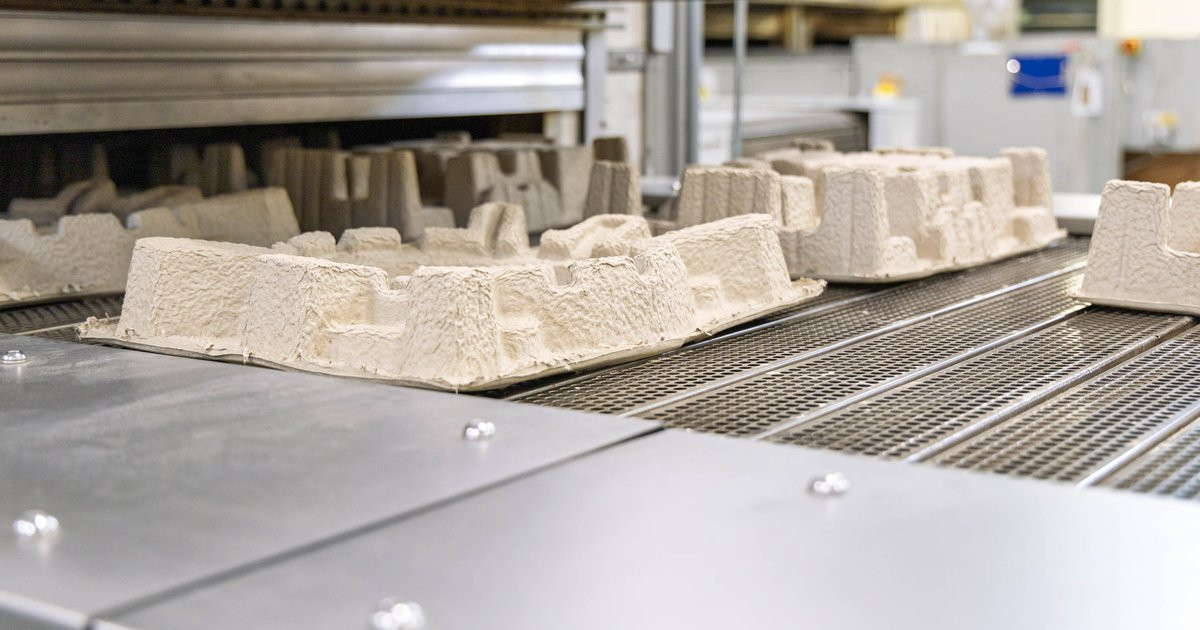
Dry press molded fibre uses a continuous production line where the wet pulp pre-form is formed first, then passes through a drying oven, and only after complete drying is transferred to a heated press die for final shaping. This sequence produces thicker walls (typically 2-5 mm), lower density, and higher impact absorption characteristics suited to protective packaging applications including e-commerce protective inserts, industrial component packaging, and transport packaging for appliances.
Both technologies use renewable wood pulp feedstock, typically sourced from FSC-certified supply chains meeting EU Deforestation Regulation (EU) 2023/1115 due diligence requirements. TRIDAS sources pulp primarily from EU low-risk regions and provides EUDR-compliant Due Diligence Statements per shipment. Production is water-intensive but operates in closed-loop systems where process water is recycled within the facility.
Surface treatments extend functional performance: barrier coatings provide moisture resistance, whilst print treatments enable brand graphics through flexographic or offset printing. Colour integration occurs either through pulp colouring (where pigment is mixed into the slurry) or surface coating. Black molded fibre, increasingly specified for premium consumer electronics packaging, requires dedicated production lines to prevent cross-contamination with natural fibre grades.
Regulatory compliance: Molded fibre packaging meets Packaging and Packaging Waste Regulation (EU) 2025/40 recyclability targets (≥70% from 1 January 2030, ≥80% from 1 January 2038) without material reformulation. Fibre-based packaging qualifies as recyclable under EN 13430 when collected through established paper and cardboard waste streams across EU member states.
Supply chain transparency: EU Deforestation Regulation (EU) 2023/1115 requires due diligence statements for wood-based products from 30 December 2026. Molded fibre suppliers with FSC chain-of-custody certification and EU-region pulp sourcing provide compliant documentation per shipment, reducing procurement administrative burden compared to materials requiring complex multi-tier traceability.
Production scalability: Industrial molded fibre production lines operate at cycle times of 3-8 seconds per part for wet press technology and 8-15 seconds for dry press [SOURCE NEEDED], enabling output volumes from 10,000 units (TRIDAS minimum order quantity) to high-volume production depending on cavity count and line configuration. Multi-cavity tooling increases throughput without proportional increases in labour or energy costs.
Impact protection performance: Dry press molded fibre provides cushioning performance comparable to expanded polystyrene (EPS) for transit packaging applications, with impact absorption validated under ISTA 2A, ISTA 3A, and ISTA 6 test protocols. Wall thickness and density can be engineered to match specific drop-test requirements for fragile products.
Brand perception alignment: Consumer research consistently shows preference for paper-based packaging over plastic alternatives in premium product categories. Molded fibre's tactile surface and natural aesthetic support brand positioning in cosmetics, fragrance, and consumer electronics segments targeting sustainability-conscious buyers.
Moisture sensitivity: Uncoated molded fibre absorbs water vapour, causing dimensional changes and strength reduction in high-humidity conditions. Barrier coatings (aqueous, wax-based, or biopolymer formulations) provide moisture resistance but add cost, with premium formulations carrying higher unit costs, and may affect recyclability depending on coating chemistry.
Geometric constraints: Molded fibre forming requires draft angles ≥3° for tool release and imposes minimum radius requirements at corners and edges. Complex geometries achievable in injection-moulded plastic (such as living hinges, snap-fit closures, and undercut features) cannot be replicated in molded fibre. Deep-draw ratios are limited for both wet press and dry press technologies.
Tooling investment: Production requires matched metal tooling (forming tool and press die) with costs ranging €5,000-20,000 per cavity set. Lead times vary with supplier capacity and design complexity; TRIDAS delivers tooling in approximately 4 weeks through in-house design and manufacturing. In contrast, thermoformed plastic packaging may use lower-cost aluminium tooling with shorter lead times, though this advantage diminishes as annual volumes increase and tooling cost per unit becomes negligible.
Surface finish variability: Wet press technology achieves smoother surfaces than dry press, but neither matches the surface uniformity of injection-moulded plastic. Visible fibre texture is inherent to the material. Print quality depends on surface density: wet press accepts offset and flexographic printing with excellent colour consistency when properly calendared, whilst dry press surfaces require heavier ink coverage and show greater colour variation.
Weight considerations: Molded fibre packaging is heavier than equivalent rigid plastic packaging. A typical cosmetics jar insert in wet press molded fibre shows materially higher weight than injection-moulded PET. For high-volume e-commerce operations, this weight difference affects shipping costs, though the impact is often offset by consolidation opportunities when replacing EPS or bubble wrap protective packaging with molded fibre alternatives.
Technology selection determines performance characteristics and application suitability. Wet press molded fibre is appropriate for premium packaging in cosmetics, fragrance, consumer electronics, and audio equipment categories where smooth surface finish, thin walls, and printability are specified. Dry press technology suits protective packaging applications in e-commerce, industrial components, and appliance transport where impact absorption and cost per cubic centimetre of cushioning are primary selection criteria.
Moisture exposure in the supply chain requires early assessment. Products stored or transported through high-humidity environments (coastal ports, tropical distribution routes, uncontrolled warehouse conditions) need barrier-coated grades. Coating specification affects both unit cost and end-of-life recyclability, requiring coordination between packaging procurement, logistics, and sustainability functions during material selection.
Tooling investment economics improve at higher annual volumes as fixed tooling costs are amortised over larger production runs. At lower volumes, tooling cost per unit becomes more significant relative to material cost. Buyers should evaluate tooling amortisation across product life cycles: consumer electronics packaging with 2-3 year product cycles requires faster tooling payback than cosmetics packaging with 5+ year stability. TRIDAS minimum order quantity is 10,000 units, varying with part complexity and tooling cavity count.
TRIDAS operates both wet press and dry press molded fibre production technologies in its Czech facility, enabling technology selection per application requirement. The company designs and manufactures its own production lines and conducts in-house tooling design, with typical tooling lead time approximately 4 weeks from order. Facility tours are available for qualified buyers evaluating production capability and quality systems.