07. 31. 2026
Molded fibre packaging is packaging formed by depositing wet cellulose pulp slurry onto shaped screens or moulds, then pressing and drying the material into three-dimensional structures. The process converts recycled paper, virgin pulp or agricultural waste into rigid, protective packaging components that biodegrade naturally. Production methods vary between dry press systems using continuous ovens and wet press systems using heated dies, determining wall thickness, surface finish and application suitability across non-food categories including cosmetics, electronics and e-commerce protective packaging.
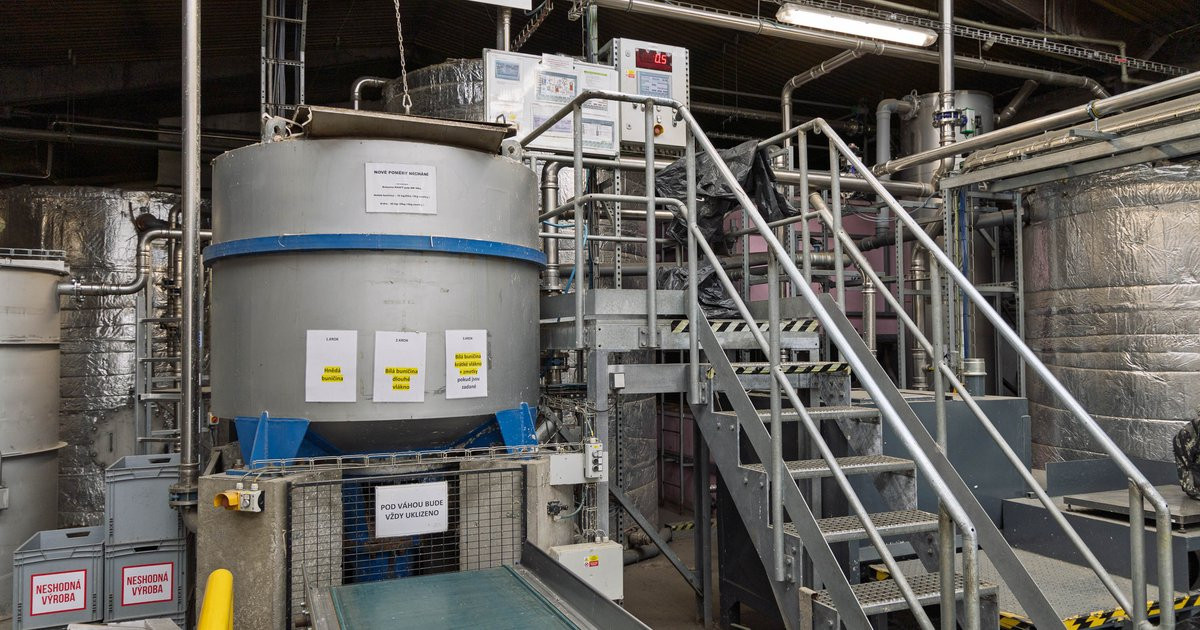
Molded fibre packaging begins as cellulose fibres suspended in water at approximately 2-5% consistency by weight. Production facilities convert recycled corrugated containers, office paper or virgin pulp into slurry in large pulpers that break down the feedstock into individual fibres. The slurry flows through refiners that mechanically treat the fibres to improve bonding characteristics, then through cleaning systems that remove contaminants including plastics, metals and adhesives.
The cleaned slurry feeds into forming stations where vacuum draws the fibre suspension onto perforated moulds. As water drains through the mould surface, cellulose fibres interlock and accumulate into a continuous mat following the three-dimensional contours of the tooling. Fibre deposition duration determines wall thickness, with typical cycles depositing material for 3-15 seconds depending on target thickness and production technology.
After forming, the wet preform contains approximately 80-85% water by weight. Production technology diverges at this stage between dry press and wet press methods, each optimised for different packaging applications and performance requirements.
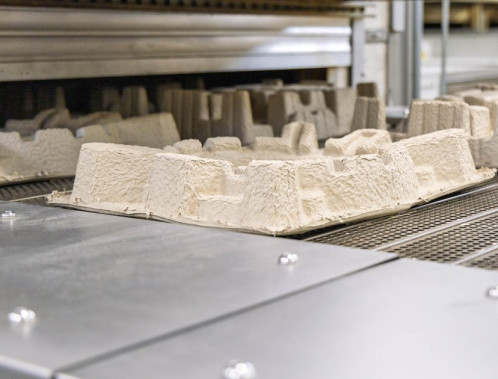
In dry press molded fibre production, the wet preform transfers to a continuous drying oven where hot air at 180-250°C removes moisture over 2-6 minutes depending on wall thickness and oven length. The dried preform then moves to a separate heated press die operating at 180-220°C and 2-8 bar pressure where final shaping occurs. This sequence produces thicker walls typically between 2-5 mm with rougher surface texture suitable for protective packaging applications including e-commerce inserts, industrial component packaging and appliance protection.
Wet press molded fibre production combines drying and final shaping in a single operation. The wet preform transfers directly into heated press dies operating at 180-220°C and 20-60 bar pressure. Steam generated from the moisture content drives through the fibre matrix while simultaneous mechanical pressure compresses the material, producing thinner walls typically between 0.8-2 mm with smoother surfaces suitable for premium packaging applications including cosmetics, consumer electronics and audio equipment packaging.
Both production methods recover process water through vacuum systems and filtration circuits, continuously recirculating water at 95-98% efficiency. Facilities supplement with fresh water only to replace evaporation losses and maintain slurry consistency. Energy consumption varies significantly between technologies, with dry press systems requiring 0.8-1.5 kWh per kilogramme for drying ovens whilst wet press systems concentrate energy into shorter press cycles.
Surface finishing occurs either in-line or offline depending on application requirements. Premium packaging grades undergo calendaring between heated rollers to improve surface smoothness for printing, whilst protective packaging typically receives no additional finishing beyond press forming. Colour can be added at the pulp stage before forming or applied as surface coatings after production.
| Material characteristic | Molded fibre | EPS foam | Corrugated board |
|---|---|---|---|
| Production method | Wet forming from pulp slurry | Bead expansion in steam chambers | Laminating and fluting paper sheets |
| Typical wall thickness | 0.8–5 mm | 15–50 mm | 3–10 mm |
| Three-dimensional forming | Single-piece complex geometries | Single-piece complex geometries | Requires folding and assembly |
| Recyclability in EU streams | Paper/cardboard stream | Separate EPS collection required | Paper/cardboard stream |
| Biodegradation timeframe | 4–12 weeks in industrial composting | 500+ years in landfill | 8–16 weeks in industrial composting |
| Surface printability | Direct offset and flexographic printing | Requires pre-printed film application | Direct printing on liner surfaces |
Procurement managers evaluating molded fibre for non-food packaging applications gain alignment with European Union regulatory requirements whilst addressing consumer pressure for plastic alternatives. Regulation (EU) 2025/40 on packaging and packaging waste sets recyclability targets for fibre-based packaging at 70% from 2030 and 80% from 2038, positioning molded fibre within established paper recycling infrastructure that achieves these thresholds today. Unlike plastic alternatives requiring separate collection systems or chemical recycling investment, molded fibre enters existing paper streams that operate at municipal level across all EU member states.
Production technology selection directly impacts packaging performance and supply chain integration. Dry press molded fibre suits applications prioritising impact absorption and cost efficiency, particularly for e-commerce protective packaging and industrial component protection where surface finish matters less than mechanical protection. Wet press molded fibre serves premium categories where surface quality, printability and product presentation influence purchase decisions including cosmetics, consumer electronics and audio equipment packaging.
Tooling investment differs substantially from plastic thermoforming or injection moulding. Molded fibre tooling consists of aluminium or composite forming moulds with perforated surfaces for vacuum forming, costing typically between lower and mid five-figure sums per cavity set depending on geometry complexity and production volume requirements. Tooling lifetime reaches 200,000-500,000 cycles before requiring refurbishment, with maintenance primarily addressing wear on perforated forming surfaces rather than complete mould replacement.
Material sourcing connects directly to European Union Deforestation Regulation (EU) 2023/1115 requirements applying from 30 December 2026. Suppliers must provide Due Diligence Statements confirming pulp origin from legal forest operations, with traceability extending to harvest coordinates for high-risk regions. Procurement specifications should require FSC chain-of-custody certification and documented pulp sourcing from EU low-risk regions to satisfy EUDR compliance obligations without additional validation overhead.
TRIDAS operates both wet press and dry press molded fibre production technologies under one roof at its Czech facility, enabling technology selection matched to application requirements rather than constraining buyers to single-method capabilities. The company designs and manufactures its own production lines, providing direct production floor insight into process optimisation and tooling design that translates into faster prototyping cycles and application-specific material formulations. TRIDAS in-house tooling manufacture delivers typical lead times of approximately 4 weeks from order compared to industry typical timeframes exceeding twelve weeks, accelerating qualification programmes for procurement teams working to compressed sustainability transition schedules. Tooling costs range EUR 5,000-20,000 per cavity set depending on geometry complexity. As an FSC-certified supplier sourcing pulp primarily from EU low-risk regions, TRIDAS provides EUDR-compliant Due Diligence Statements per shipment under Regulation (EU) 2023/1115.