07. 31. 2026
Consumer electronics brands sourcing protective packaging face electrostatic discharge risks that can destroy sensitive components during handling and transit. Anti-static and ESD-safe molded fibre packaging addresses this requirement through controlled surface resistivity formulations and validated discharge rates, enabling direct contact with circuit boards, displays and semiconductors while maintaining the material's recyclability advantage over plastic alternatives. Manufacturers achieve ESD protection through carbon fibre additives, conductive polymers or topical coatings applied during or after the forming process, with surface resistivity values verified per IEC 61340-5-1 requirements before shipment.
Anti-static and ESD-safe molded fibre packaging protects electronic components from electrostatic discharge through controlled electrical conductivity engineered into the fibre matrix. Standard molded fibre, composed of cellulose fibres and water, functions as an insulator with surface resistivity exceeding 10¹² ohms. Electronics applications require surface resistivity between 10⁴ and 10¹¹ ohms to safely dissipate static charges without creating rapid discharge paths that damage sensitive circuits.
Manufacturers achieve ESD-safe properties through three primary methods. Carbon fibre additives, typically representing 2–8% of dry pulp weight, create conductive pathways throughout the fibre matrix during the forming process. Conductive polymer additives, applied during pulp preparation, coat individual cellulose fibres with electrically conductive materials. Topical coatings, applied after forming and drying, create a conductive surface layer through spray or dip application of graphene-based or metal-particle formulations.
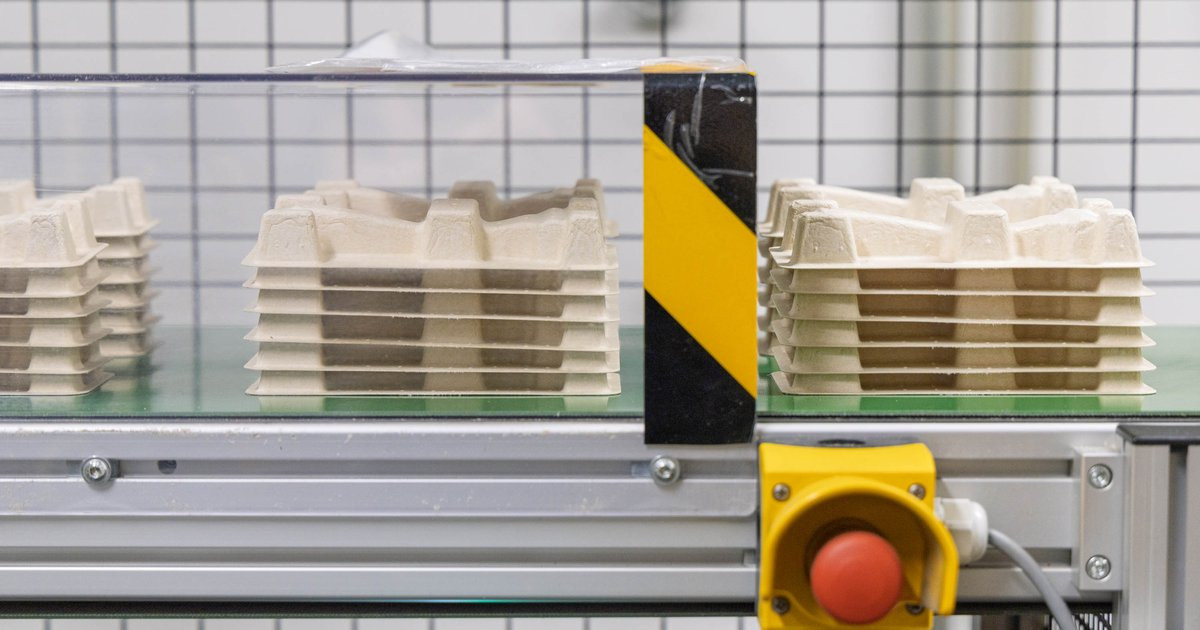
The forming process for ESD-safe molded fibre follows the same production sequence as standard packaging. Wet press technology proves particularly suitable for electronics packaging due to its ability to produce thin walls (0.8–2 mm), smooth surfaces and precise dimensional tolerances. The wet pulp suspension, containing the conductive additives, transfers onto a heated forming tool. The tool closes under pressure, simultaneously shaping the packaging and dewatering the pulp. Heat from the tool (typically 180–220°C) accelerates water evaporation while consolidating the fibre matrix around the conductive additives.
Surface resistivity testing occurs at multiple production stages. Initial validation measures resistivity across the formed surface using a two-point probe meter per IEC 61340-2-3 methodology. Production samples undergo verification at defined intervals, typically every 500–1000 units depending on customer requirements. Test points follow a standardised grid pattern to confirm uniform conductivity across the entire packaging surface, with particular attention to corners and embossed features where fibre density variations can affect electrical properties.
Black molded fibre, produced on dedicated production lines, addresses both aesthetic preferences and recycling considerations for electronics packaging. The black colouration derives from carbon additives that provide the ESD-safe properties, eliminating the need for separate pigments. This approach prevents contamination of recycling streams with incompatible colorants while maintaining the premium visual appearance electronics brands require for retail presentation.
| Property | ESD-safe molded fibre | Conductive foam | Anti-static plastic tray |
|---|---|---|---|
| Surface resistivity range | 10⁴–10¹¹ ohms (IEC 61340-5-1) | 10³–10⁶ ohms | 10⁹–10¹² ohms |
| Wall thickness typical | 0.8–2 mm (wet press) | 3–10 mm | 1.5–3 mm |
| Recyclability EU | Paper stream (EN 643) | Non-recyclable | Plastic stream (limited) |
| PPWR compliance | ≥70% recyclable (2030 target) | Exempt (cushioning) | Requires design modification |
| Tooling lead time typical | 4–8 weeks | 8–12 weeks | 12–16 weeks |
| Material density | 0.4–0.6 g/cm³ | 0.03–0.08 g/cm³ | 0.9–1.2 g/cm³ |
| Drop height protection | 60–100 cm (design-dependent) | 100–150 cm | 40–80 cm |
Procurement teams evaluating ESD-safe packaging for consumer electronics face intersecting technical and regulatory requirements. PPWR Regulation (EU) 2025/40, applying from 12 August 2026, establishes recyclability targets of 70% by 2030 and 80% by 2038 for fibre-based packaging. ESD-safe molded fibre meets these requirements through paper-stream recyclability under EN 643 grade classifications, while conductive foams and many anti-static plastics require design modifications or face compliance difficulties.
Component protection requirements determine material selection. Products containing semiconductors, LCD displays, OLED screens or exposed circuit boards require packaging with verified surface resistivity in the dissipative range (10⁶–10¹¹ ohms) to prevent component damage during handling and transit. Finished goods packaging for assembled devices typically tolerates anti-static properties (10⁹–10¹² ohms), which prevent static attraction of dust particles without requiring full ESD protection. This distinction affects additive selection and testing protocols during production qualification.
Supply chain considerations include testing verification, traceability documentation and regulatory compliance statements. Each production batch should include surface resistivity test reports with measurements taken at defined grid points across sample packaging. IEC 61340-2-3 methodology provides the standard testing protocol for B2B verification. EUDR compliance, mandatory from 30 December 2026 under Regulation (EU) 2023/1115, requires Due Diligence Statements confirming pulp sourcing from legal forestry operations with verified geolocation data.
Tooling investment and production lead times affect programme launch schedules. Typical tooling lead time for molded fibre spans 4–8 weeks from design approval to first article, substantially shorter than injection-moulded plastic alternatives. Production capacity planning should account for surface resistivity testing intervals, which extend cycle times by approximately 5–10% compared to standard molded fibre production due to additional quality verification steps.
TRIDAS operates both wet press and dry press molded fibre production technologies at its Czech facility, enabling technology selection based on electronics packaging requirements. Wet press production proves particularly suitable for compact consumer electronics, delivering wall thickness of 0.8–2 mm with smooth surfaces that accommodate printed assembly instructions and regulatory markings. The company launched dedicated black molded fibre production lines in 2026, supporting electronics applications where aesthetic consistency and ESD properties align. TRIDAS is FSC-certified and provides EUDR-compliant Due Diligence Statements per shipment under Regulation (EU) 2023/1115, addressing supply chain transparency requirements for electronics brands operating across EU markets. Facility tours are available for qualified procurement teams evaluating production capabilities and quality verification protocols.