08. 12. 2026

The PPWR 40 percent rule requires e-commerce packaging to contain at least 40 percent recycled content from 12 August 2030 under Regulation (EU) 2025/40. Molded fibre protective packaging meets this requirement using recycled paper pulp sourced from post-consumer waste streams, eliminating the need for material blending or virgin content supplementation that plastic alternatives require to reach the same threshold.
Article 6 of Regulation (EU) 2025/40 establishes minimum recycled content requirements for specific packaging categories. E-commerce packaging — defined as packaging used for distance sales to end users — must contain at least 40 percent recycled content by weight from 12 August 2030. This requirement applies to all material types used in e-commerce protective inserts, void fill, and secondary transit packaging within the EU/EEA market.
The regulation defines recycled content as material generated from manufacturing waste (pre-consumer) or post-consumer waste that has been reprocessed into packaging. Virgin materials, bioplastics derived from renewable feedstocks, and mechanically recycled content from industrial loops do not count toward the 40 percent threshold unless they originate from genuine waste streams. Suppliers must provide documentation demonstrating recycled content percentage per shipment, traceable to certified waste processing facilities.
For plastic packaging, achieving 40 percent recycled content requires blending recycled polymer with virgin resin to maintain mechanical properties. Recycled polypropylene and recycled polystyrene exhibit reduced impact strength and dimensional stability compared to virgin grades, limiting their use in protective applications without virgin supplementation. Recycled plastics also face quality variation between batches, creating colour consistency and processing challenges that require ongoing material adjustment.
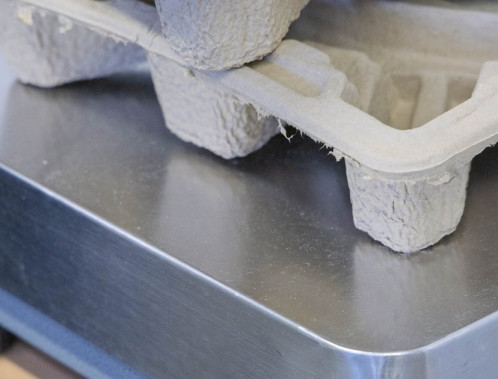
Molded fibre protective packaging bypasses these blending requirements entirely. The material composition is recycled paper pulp — typically 85–100 percent post-consumer waste sourced from sorted paper grades under EN 643 classification. The pulp forms into three-dimensional protective structures through hydraulic forming and pressing, creating impact-absorbing packaging without polymer binders or virgin content supplementation. The recycled content percentage remains consistent across production runs because paper pulp composition does not affect forming behaviour in the same way recycled plastic composition affects injection moulding.
Compliance documentation for molded fibre packaging consists of FSC chain-of-custody certificates tracing pulp origin and processing facility declarations confirming recycled content percentage. These documents establish PPWR Article 6 compliance at the point of packaging supply, eliminating the need for downstream testing or batch-specific verification that plastic alternatives require.
| Attribute | Molded fibre (wet press) | Molded fibre (dry press) | Expanded polystyrene foam | Recycled polypropylene |
|---|---|---|---|---|
| Recycled content (typical) | 85–100% | 85–100% | 0–30% | 40–60% |
| PPWR 40% compliance | Direct compliance | Direct compliance | Requires virgin blend | Requires virgin blend |
| Wall thickness | 0.8–2 mm | 2–5 mm | 15–50 mm | 2–6 mm |
| Density | 0.3–0.8 g/cm³ | 0.3–0.8 g/cm³ | 0.02–0.05 g/cm³ | 0.9–1.2 g/cm³ |
| Compression strength | 200–400 N per 100 mm² | 200–400 N per 100 mm² | 50–150 N per 100 mm² | 400–800 N per 100 mm² |
| Drop-test capability (ISTA 3A) | Up to 5 kg payload | Up to 5 kg payload | Up to 10 kg payload | Up to 15 kg payload |
| Material cost (€/tonne) | Lower material cost | Lower material cost | Higher material cost | Higher material cost |
| Tooling lead time | ~4 weeks | ~4 weeks | 6–10 weeks | 8–12 weeks |
| End-of-life route (EU) | Paper recycling stream | Paper recycling stream | Specialist EPS recycling | Mixed plastic recycling |
Procurement teams specifying e-commerce protective packaging face a material selection decision driven by PPWR compliance timelines. The 40 percent recycled content requirement applies from 12 August 2030, giving organisations four years to redesign packaging systems, qualify alternative materials, and establish compliant supply chains. Switching from expanded polystyrene foam or virgin polypropylene to molded fibre eliminates the recycled content blending process and associated supplier verification burden.
For consumer electronics applications — including smartphones, tablets, audio equipment, wearables, and accessories — wet press molded fibre delivers thin-wall protective inserts that fit within existing carton dimensions. Wall thicknesses of 0.8–2 mm provide sufficient impact absorption for products up to 5 kg under ISTA 3A transit testing while maintaining the tight tolerances required for device positioning and cable management channels. The smooth surface finish supports printing directly onto the insert surface, enabling branding and assembly instructions without additional printed cards.
For appliance and furniture e-commerce packaging, dry press molded fibre delivers thicker protective inserts with 2–5 mm walls suitable for corner protectors, edge guards, and base pads. The higher impact absorption of dry press construction handles heavier payloads while maintaining recyclability in standard paper waste streams. Dry press molded fibre replaces expanded polystyrene foam blocks without requiring carton redesign, because the material compresses to similar cushioning performance at lower volume.
Cost implications depend on order volume and tooling amortisation. Molded fibre tooling costs €5,000–20,000 per cavity set — comparable to plastic injection moulding tooling — but molded fibre tooling lead times run approximately 4 weeks compared to 8–12 weeks for plastic tooling. Material costs favour molded fibre: recycled paper pulp is a substantially cheaper input than virgin polypropylene. At higher annual volumes, tooling costs amortise across larger unit counts, improving per-part economics. TRIDAS minimum order quantity is 10,000 units, varying with part complexity and tooling cavity count.
Sustainability leads integrating molded fibre into e-commerce packaging systems gain PPWR recycled content compliance, EUDR deforestation-risk compliance under Regulation (EU) 2023/1115, and recyclability pathway alignment with PPWR targets of 70 percent fibre-based packaging recyclability from 2030 and 80 percent from 2038. Molded fibre enters existing paper recycling infrastructure without specialist collection or sorting requirements, maintaining end-of-life value that expanded polystyrene foam and mixed-plastic packaging cannot deliver.
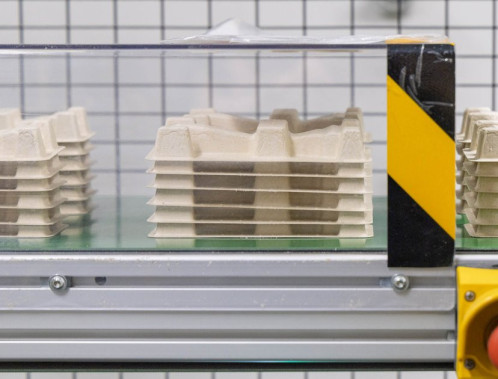
TRIDAS operates both wet press and dry press molded fibre production technologies under one roof at its Czech facility, enabling technology selection per application requirement. For e-commerce electronics packaging, wet press lines deliver thin-wall inserts with smooth surfaces suitable for direct printing and tight device tolerances. For appliance and furniture protective packaging, dry press lines deliver thicker impact-absorbing structures with faster production cycles. TRIDAS is FSC chain-of-custody certified and provides EUDR-compliant Due Diligence Statements per shipment under Regulation (EU) 2023/1115, sourcing pulp primarily from EU low-risk regions. Tooling lead times run approximately 4 weeks from order, and TRIDAS conducts facility tours for qualified buyers evaluating production capabilities and equipment integration requirements.