09. 30. 2026
Molded fibre agricultural packaging serves horticultural operations, nurseries and professional growing environments through seedling pots, plant trays, root-ball containers and protective transport packaging for live plants. These applications replace plastic pots and polystyrene trays with biodegradable fibre alternatives that integrate directly into planting systems, reducing transplant shock and eliminating post-use plastic waste from commercial growing operations.
Molded fibre agricultural packaging comprises biodegradable plant containers, seedling trays, root-ball wraps and protective transit packaging designed for horticultural applications. These products serve commercial nurseries, forestry operations, municipal planting programmes and professional growing facilities rather than retail garden centres.
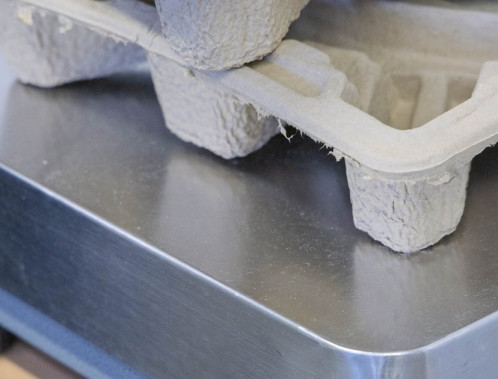
The primary application is biodegradable plant pots. Unlike plastic pots that require removal before planting, molded fibre pots plant directly into soil or growing media. Root systems penetrate the fibre walls as plants develop, eliminating the transplant shock associated with root disturbance during repotting. Wall thickness typically ranges 2-4 mm to provide structural integrity during growing periods whilst remaining permeable to root penetration.
Dry press molded fibre technology produces most agricultural containers. The thicker walls and higher porosity of dry press material support moisture management in growing environments. Air exchange through the fibre structure prevents root circling – a condition where roots grow in circles around the pot interior rather than penetrating outward. This structural difference from plastic pots produces healthier root systems and higher transplant success rates [SOURCE NEEDED].
Material composition uses unbleached pulp without coatings or waterproofing treatments that would inhibit biodegradation. Pots biodegrade completely within soil environments over 8-12 weeks [SOURCE NEEDED], breaking down into organic matter that integrates into the growing substrate. This eliminates the collection, cleaning and disposal logistics associated with plastic pot reuse systems in commercial nurseries.
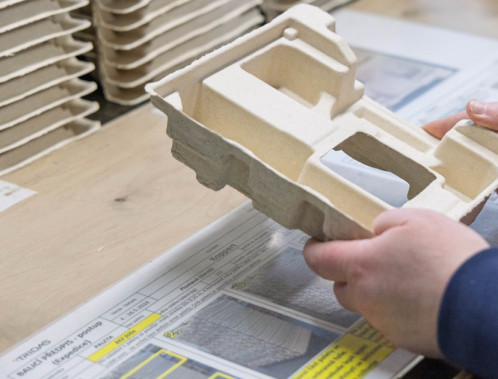
Transport packaging for live plants uses similar dry press construction. Protective inserts stabilise root balls during distribution whilst the fibre structure absorbs moisture from irrigation and condensation. Wall thickness increases to 3-5 mm for transit applications where compression resistance matters more than biodegradation speed.
Horticultural trays for seedling production follow the same construction principles. Multi-cavity designs separate individual plants whilst the continuous tray structure simplifies handling in automated growing systems. Draft angles between cavities accommodate root development without restricting extraction during transplanting operations.
| Parameter | Molded fibre pots | Plastic injection pots | Peat pots |
|---|---|---|---|
| Wall thickness | 2-4 mm | 1-2 mm | 3-6 mm |
| Biodegradation time | 8-12 weeks [SOURCE NEEDED] | Non-biodegradable | 4-8 weeks [SOURCE NEEDED] |
| Root penetration | Direct through walls | Blocked | Direct through walls |
| Moisture permeability | High | Zero | Very high |
| Structural integrity (wet) | Maintains shape 4-8 weeks [SOURCE NEEDED] | Permanent | Weakens after 2-4 weeks [SOURCE NEEDED] |
| Material cost per unit | Higher | Lower | Comparable |
| End-of-life | Plant with container | Collect and dispose/reuse | Plant with container |
Procurement decisions for agricultural packaging balance material costs against operational savings. Molded fibre pots cost more per unit than plastic alternatives due to the density difference – fibre pots use more material weight per unit than plastic, though recycled paper pulp is a substantially cheaper input than virgin polymers. However, molded fibre eliminates the labour and logistics costs associated with plastic pot collection, cleaning, sorting and redistribution in reusable systems.
The operational benefit concentrates in transplanting efficiency. Planting molded fibre pots directly into soil reduces labour time per plant compared to extracting plants from plastic containers. For large-scale forestry or municipal planting operations processing thousands of units, this time saving accumulates into measurable cost reduction [SOURCE NEEDED].
Waste management costs also shift. Plastic pots that enter municipal waste streams incur disposal fees. Molded fibre pots planted with their contents generate no post-use waste requiring collection or processing. This matters most in commercial operations where pot accumulation creates storage and handling problems.
Technical specifications require attention during procurement. Wall thickness affects both growing-period durability and biodegradation timing. Thinner walls (2 mm) suit short-cycle crops where transplanting occurs within 4-6 weeks. Thicker walls (3-4 mm) support longer growing periods but extend biodegradation time. Buyers specify wall thickness based on crop cycles rather than selecting generic products.
Volume economics differ from retail packaging. Tooling costs of EUR 5,000-20,000 per cavity set spread across production runs, so minimum order quantities start from 10,000 units, varying with part complexity and tooling cavity count. Multi-cavity tooling reduces unit costs but requires consistent demand across growing seasons.
Moisture management becomes critical in greenhouse environments with high irrigation frequency. Excessive moisture accelerates fibre breakdown before transplanting. Buyers specify basis weight (typically 600-900 g/m²) to balance structural integrity against biodegradation requirements for specific growing conditions.
TRIDAS operates dry press molded fibre production technology suitable for thicker-walled agricultural containers. The technology produces the wall thicknesses and porosity characteristics that horticultural applications require. TRIDAS sources pulp primarily from EU low-risk regions and provides EUDR-compliant Due Diligence Statements per shipment under Regulation (EU) 2023/1115, addressing supply-chain transparency requirements for buyers operating under deforestation-free sourcing policies. Tooling design and manufacturing occurs in-house at the Valašské Meziříčí facility, with typical lead times of approximately 4 weeks from order to production-ready tooling.